Back to Blog
Building a Service Business That Runs Without You: Systems and Delegation for Coaches and Consultants in 2026
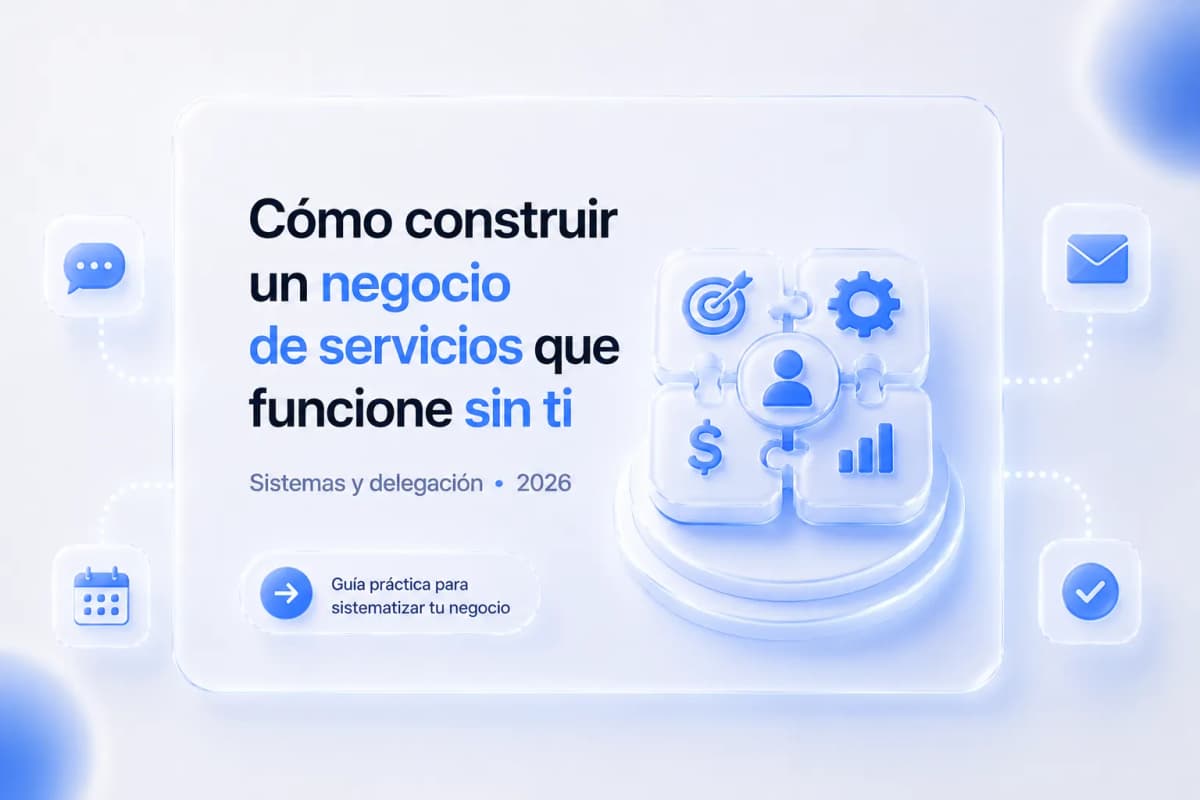
A service business that depends 100% on you isn't a business — it's a job with clients. Most coaches and consultants work more hours than they would at a regular job, with no real vacations and revenue that depends on whether they had energy last week. The solution isn't working harder — it's building systems. This guide covers how to diagnose your business's dependency on you, the 4 systems that let it operate without your constant presence, and the path to working 20–25 high-value hours per week instead of 60.
The Diagnosis: What Would Break If You Took 2 Weeks Off?
This is the most honest question for measuring how systematized a service business actually is. If the answer is "everything," you don't have a business — you have self-employment with better branding.
Four concrete signs your business depends on you:
- You can't take real time off without clients or revenue suffering. If leaving for 10 days means no one responds to prospects, delivery falls behind, or your pipeline freezes — you don't have systems. You have you doing everything.
- You're the only one who knows how to deliver the service. No one else could replicate it at the same standard, because the process lives in your head, not in documentation.
- Sales stop if you're not actively prospecting. If the main source of new clients is you opening Instagram or WhatsApp every day and following up by hand, your acquisition system runs on your time and energy — not on a process.
- This month's revenue depends on last week's energy. If you had a hard week or got sick, next month bills less. That's a job, not a business.
The goal isn't to disappear from your business. It's to choose when and how you work, and have the business not stop when you're not there. The operational target: owner working 20–25 hours per week on high-value work (strategy, closing high-ticket sales, key client relationships), with everything else delegated or automated.
The 4 Systems Every Service Business Needs
A service business needs four systems to run without the owner. If one is missing, the owner fills the gap — and the time "freed" by the other three gets consumed by that single bottleneck.
1. Client Acquisition
The acquisition system works when it generates leads predictably without the owner prospecting manually every day. The components:
- Consistent traffic: Meta Ads running continuously (even at $5–$10 USD/day), or an organic content strategy with regular publishing that doesn't depend on the owner recording and posting personally.
- Automatic first response: any prospect who messages via DM or WhatsApp receives a reply within minutes, 24/7 — not when the owner picks up their phone.
- Automated qualification and booking: the prospect answers 2–3 questions and books directly on the owner's calendar, with no manual scheduling coordination.
2. Service Delivery
Delivery is systematized when every stage has a responsible party, a documented process, and the client can move forward without waiting for the owner to be available.
- Each session, deliverable, or milestone has a defined date and owner from the start of the project.
- The client has access to the resources they need (client portal, shared folder, session recordings) without having to ask for them.
- The quality standard is written down — not in the owner's head.
3. Billing and Payments
Money comes in without the owner having to request it. The components:
- Active payment link: Stripe, PayPal, or another payment processor — the client pays on their own, no bank transfer coordination required.
- Automatic payment reminders: for installment plans, the reminder goes out automatically 3 days before the due date.
- Invoicing without manual intervention: whether the assistant handles it or the system generates it automatically.
4. Retention and Follow-Up
Current clients are the most efficient source of new revenue — but only if there's a system that maintains contact after the service ends.
- Post-service follow-up sequence: a message at 30, 60, and 90 days checking on results.
- Scheduled check-in: a 20-minute call booked automatically one month after the service closes.
- Referral system: a structured referral request that goes out automatically when client satisfaction is at its peak (typically weeks 3–4 of the service).
How to Document a Process in 30 Minutes
The most common argument against documentation: "I don't have time." The method that works doesn't require writing a manual — it requires 30 minutes and two tools:
Step 1 — Record while you do it (15 minutes):The next time you execute the process, open Loom and record your screen while narrating out loud every step you take and why. Don't edit. Don't perfect it. Just show how you actually do it in real time.
Step 2 — Write the checklist from the video (10 minutes):Watch the video and write a numbered list of every concrete action you took. No long explanations — just the steps. This list is what someone else can follow to replicate the result.
Step 3 — Name and save (5 minutes):Standard naming: [Process] — [Who does it] — v1. For example: "New prospect response — Assistant — v1". Upload it to Notion, Google Drive, or wherever your team works.
The SOP doesn't need to be perfect to work. An 8-step checklist with a 12-minute video is worth more than a 30-page manual no one reads. Update only when the process changes.
What to Delegate First: The Impact vs Energy Matrix
Not every task deserves your time, and not every task deserves to be delegated with the same urgency. The impact-vs-energy matrix helps prioritize:
|
|
Low impact on results |
High impact on results |
|---|---|---|
|
High energy for you |
Delegate immediately |
Automate or delegate with oversight |
|
Low energy for you |
Automate |
Do it yourself — this is your high-value zone |
Delegate immediately (high energy + low impact):Responding to follow-up emails, coordinating schedules, updating the CRM, publishing already-created content, chasing pending payments, repetitive administrative tasks. These consume disproportionate mental energy relative to what they contribute — and a virtual assistant with a clear SOP can handle them.
Automate (low energy + low impact):Appointment reminders, booking confirmations, new client welcome messages, payment received notifications. Automation tools handle these perfectly with no human involvement.
Automate or delegate with oversight (high energy + high impact):First response to prospects (the automation qualifies; the owner closes), delivery of parts of the service that can be standardized (specialist executes; owner reviews quality).
Do it yourself (low energy + high impact):Business strategy, high-ticket sales closes, key client relationships, live content that requires your voice and judgment. This is where 80% of your 20–25 weekly hours should go.
Hire vs Automate: What AI Can Handle Alone vs What Needs a Person
|
Task |
AI / automation (no person needed) |
Needs a person |
|---|---|---|
|
First response to new prospect |
✓ — reply in seconds, 24/7 |
For closing or complex objections |
|
Basic prospect qualification |
✓ — structured questions, auto-tagging |
For cases outside the usual script |
|
Call scheduling |
✓ — Calendly or similar, no coordination |
For schedule exceptions |
|
Appointment and payment reminders |
✓ — 100% automatable |
No person needed |
|
Post-service follow-up (weeks 1–3) |
✓ — scheduled sequence |
For issues or re-purchases |
|
Scheduled content publishing |
✓ — Buffer, Meta Business Suite |
For spontaneous or live content |
|
Core service delivery |
Partly — PM tools, client portals |
Judgment and adaptation require a person |
|
High-ticket sales close |
No — relationship and judgment are human |
Always a person |
|
Client problem resolution |
No |
Always a person |
The practical rule: if a task has a predictable outcome and follows fixed steps, AI or a tool can handle it. If it requires adapting to new context, independent judgment, or real-time empathy, it needs a person.
Your First Virtual Assistant: How to Find and Onboard Them in 2 Weeks
Where to Find Them
- Upwork: strong pool of vetted freelancers for virtual assistance, writing, and admin tasks. Typical cost: $10–$20 USD/hour or $600–$1,200/month full-time.
- LinkedIn: better for mid-level specialists with marketing or operations backgrounds; useful if you want someone with existing tool fluency.
- Personal referrals: for roles with access to CRM, client messages, or financial information, a referral from someone you trust is worth more than any platform.
- Niche communities: Facebook groups and Slack channels for virtual assistants or online business operations — the advantage is that the profile already understands the digital business environment.
2-Week Onboarding Plan
Week 1 — Process and tools:
- Days 1–2: access to tools (Google Workspace, Notion/Trello, CRM, Calendly), reading of existing SOPs, direct Q&A with the owner.
- Days 3–4: shadowing the owner on every task in their role — the assistant observes how each thing is done.
- Day 5: the assistant executes the tasks with the owner available to clarify in real time.
Week 2 — Supervised execution:
- Days 1–3: the assistant works independently and reports at end of day: what they did, any blockers, what they're doing tomorrow.
- Days 4–5: the owner reviews outputs and gives specific feedback; only intervenes for errors or out-of-script cases.
By the end of 2 weeks, the assistant must be able to do independently:
- Manage the inbox using the defined protocol (respond, triage, escalate to the owner only what requires it)
- Book calls without consulting every case
- Update the CRM after every interaction
- Publish content according to the approved calendar
- Follow up with prospects using the message script
If they still need constant supervision on any of these after 2 weeks, the problem is almost always the SOP, not the person.
Systematization Checklist
- [ ] Identified the 3 tasks that consume most of my time each week
- [ ] Documented the core service delivery process (video + checklist = SOP v1)
- [ ] Have a scheduling system with no manual coordination required (Calendly or similar)
- [ ] Have an active payment link (Stripe, PayPal, or equivalent)
- [ ] Have an automatic first response for new prospects (DM or WhatsApp)
- [ ] Have a scheduled post-service follow-up sequence
- [ ] Applied the impact-vs-energy matrix and know which tasks to delegate first
- [ ] Have a first virtual assistant or a concrete plan to hire one this month
Ready to Get More Clients?
At Asio, we teach you to implement these strategies step by step through the Mastery program — combining Meta Ads and conversational automation so you get more appointments and close more sales, without relying on manual messages.