Back to Blog
Year-End Campaigns for Service Businesses: Black Friday, Christmas, and January 2026
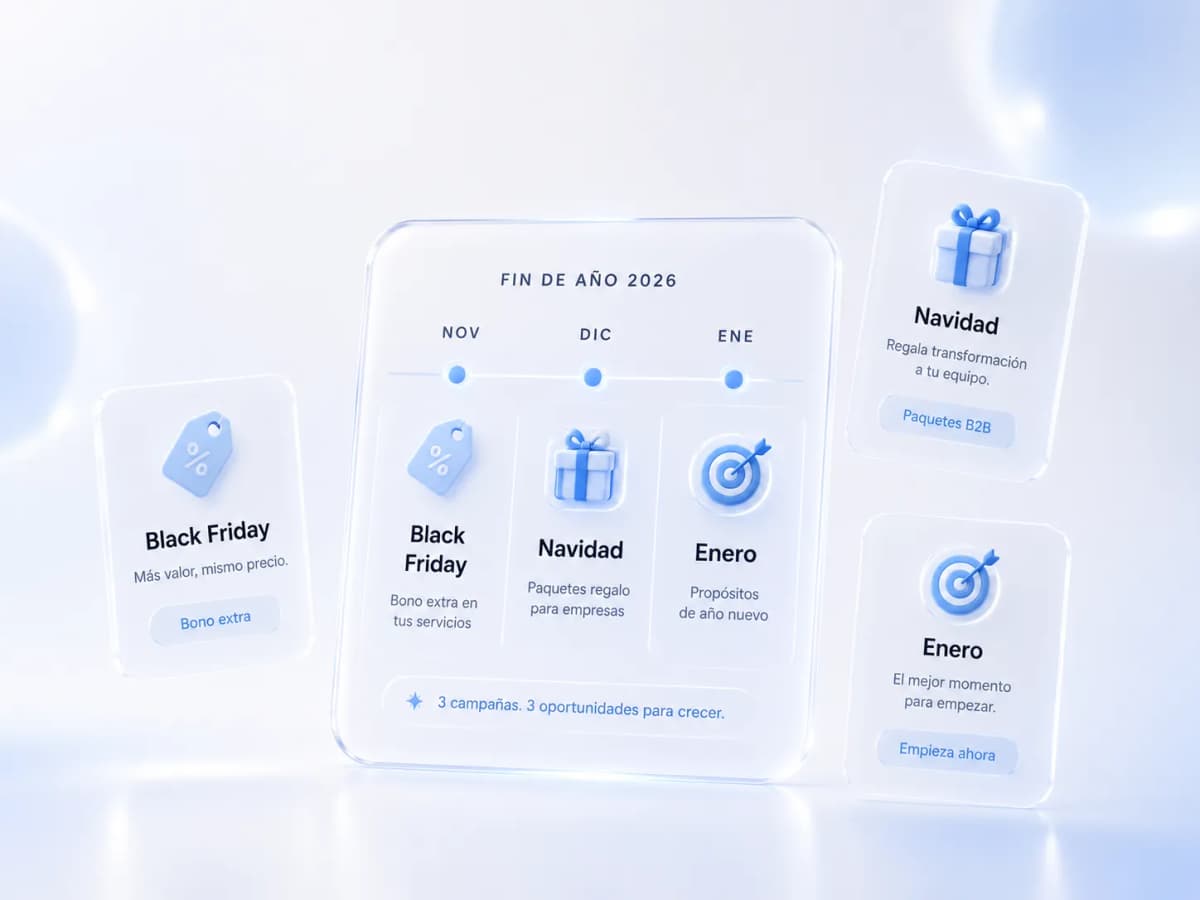
Every November, thousands of coaches, consultants, agencies, and service professionals skip seasonal campaigns because they assume promotions are for product retailers. The result: leaving the busiest buying window of the year untouched. This guide covers the three campaigns worth running — Black Friday, Christmas, and January — and how to execute each without discounting your way to a lower price anchor.
Why Q4 Works for Service Businesses
Most service professionals think of Q4 as a slow period for new clients. The opposite is true if you know which buyer signals to look for.
Annual budgets with December deadlines. B2B buyers — companies purchasing coaching, consulting, training, and marketing services — operate on annual budgets. What isn't spent by December 31 typically disappears. A consultant or agency that shows up in November with a clear proposal is talking to buyers who have approved budget and a real deadline to use it.
Q4 is when next-year decisions are made. Most purchases of coaching, therapy, consulting, and transformation services are decided in October–December, not January. By the time January arrives, most buyers have already chosen who they're working with. If you're not in the consideration set during Q4, you're competing for the leftovers in January.
New year intent peaks in early January. For services that promise personal or professional transformation — fitness, coaching, therapy, business consulting — January 1–20 is the highest-intent buying window of the year. The decision to buy, however, is typically made in December.
Black Friday for Service Businesses: Bonus Over Discount
The first question service professionals ask about Black Friday: how much should I discount?
The answer: as little as possible — and ideally zero.
Why a Bonus Beats a Discount Every Time
A 30% discount on a $500 service costs you $150 in margin and, more importantly, signals to the prospect that the service "really" costs $350. That discounted price becomes the new psychological anchor. Charging full price in January after a Black Friday discount triggers price resistance from the same person.
A bonus offer that provides $150 in perceived value can cost you close to nothing — a digital resource you already created, an extra session within your existing schedule, 30-day access to a community you already run. The message shifts from "now cheaper" to "now more":
|
Offer type |
Client price |
Implicit message |
Long-term effect |
|---|---|---|---|
|
30% direct discount |
$350 (was $500) |
"The real price was $350" |
Devalues the service; recovering full price later triggers friction |
|
Bonus add-on |
$500 + bonus |
"More for the same investment" |
Price anchor stays intact; bonus reinforces value |
|
New package tier |
$700 (2–3 services) |
"Chance to access more" |
Average ticket goes up, not down |
What to Offer as a Bonus by Service Type
- Coach or consultant: an extra session, access to a masterclass, a strategy template, or 30-day community access
- Marketing agency: a free account audit, an extended Q1 strategy session, or an extra reporting month
- Health professional (nutritionist, therapist): a follow-up session, a 30-day digital care plan, or priority scheduling in January
- Trainer or fitness coach: a program extension, a personalized meal plan, or a group workshop
The bonus should feel high-value without costing you real margin. Digital resources you already built, time already blocked in your schedule, or access to existing infrastructure are the best candidates.
Christmas Campaign: B2B Gift Packages
The Christmas campaign has an angle most service professionals completely miss: companies buy services as gifts for employees, partners, and key clients.
A mid-sized company that wants to give something meaningful to its 15 managers doesn't want to send them a box of chocolates. It wants to give them something that makes them better at their jobs — coaching sessions, a professional development program, a wellness plan, or strategic consulting for the upcoming year.
How to structure a B2B gift package:
- Volume-based pricing: offer blocks of 5, 10, or 20 sessions at a special Christmas rate. This is volume pricing, not per-unit discounting — and it preserves the positioning.
- Redeemable format: deliver a code or voucher for each session. The company distributes them to employees, who book individually at their convenience.
- Simple purchase process: a PDF proposal, payment by bank transfer or invoice, with group onboarding in January. Make it easy for the buyer to say yes without complex logistics.
Corporate "training" and "employee wellness" budgets need to be spent before fiscal year close. A well-packaged professional services offer competes directly with corporate dinners and team trips — often favorably, because it's something the employee can actually use.
To reach this market: Meta Ads targeted to business owners, HR directors, and operations managers at mid-sized companies, combined with a direct broadcast to existing B2B clients offering early access.
The January Campaign: New Year Intent as a Sales Trigger
January is the best month of the year to sell transformation services, and most professionals waste it waiting for people to "have money again" after the holidays.
The reasoning error: January isn't the month people have the most money — it's the month they have the most intention to change. And purchase intent triggered by a desire for change is the most powerful buying signal that exists for coaches, therapists, nutritionists, business consultants, and any service that promises a concrete improvement.
The high-intent window in January is January 2–20. After the 20th, new-year resolve starts fading and the willingness to commit to change drops. The best results come from the first two weeks.
The message that converts in January:
Not "Happy New Year — book a consultation!" It's connecting your service directly to the prospect's stated goal and giving them a real reason to start now:
❌ "Start the year right — schedule your session today!"✅ "You said you wanted [specific outcome] this year. This is the system that gets you there — and starting in January gives you the whole year to compound the results before the routine takes over again."
Reactivating Cold Leads in January
January is the one time of year when a reactivation broadcast to all cold leads from the past 6 months makes sense. The message is not a sales pitch — it's reconnection in context:
"Hey [Name], hope the new year is off to a good start. Reaching out because we talked a few months back about [service] and I wanted to see if the timing might be better now. January is when most people make the decisions that shape the rest of their year — no pressure, but I'm here if you want to pick up the conversation."
Reactivation broadcasts in January get significantly higher response rates than the same message in any other month, because the context makes the outreach feel timely rather than intrusive.
Campaign Calendar: November Through January
|
Period |
Campaign |
Key actions |
|---|---|---|
|
Week -2 |
Preparation |
Define the bonus, create the ad creative, configure the WhatsApp or DM flow, segment the broadcast list |
|
Week -1 |
Pre-launch |
Teaser content on social ("something's coming"), broadcast to existing clients with early access, activate the ad at $10–$20 USD/day to warm the pixel |
|
Event week |
Active launch |
Scale ad budget to $30–$60 USD/day, send the main broadcast, respond to DMs and WhatsApp within 2 hours of receiving messages |
|
Week +1 |
Close and follow-up |
"Last few days" ad, follow up with leads who started a conversation but didn't close, deactivate the ad when the window closes |
Ad Strategy by Season
- Black Friday (week before + event week): objective Messages (Click-to-DM or Click-to-WhatsApp). Creative with the bonus clearly visible. Audience: warm audiences (followers, contact list, website visitors) + lookalike from closed clients.
- Christmas / B2B (December 1–15): objective Traffic or Leads. Ad targeted to business decision-makers. Message focused on "corporate gift" or "year-end budget" framing.
- January (January 2–20): objective Messages. Creative with transformation and new-year intent angle. Reactivation broadcast running in parallel.
Ready to Get More Clients?
At Asio, we teach you to implement these strategies step by step through the Mastery program — combining Meta Ads and conversational automation so you get more appointments and close more sales, without relying on manual messages.