Back to Blog
Financial Metrics Every Service Professional Should Monitor in 2026
Most service professionals in LATAM only check how much came in each month — not how much it cost to get it, or how much each client is worth over time. Those two blind spots explain why a business can have high-revenue months and still not grow.
The 5 Metrics and Why They Work Together
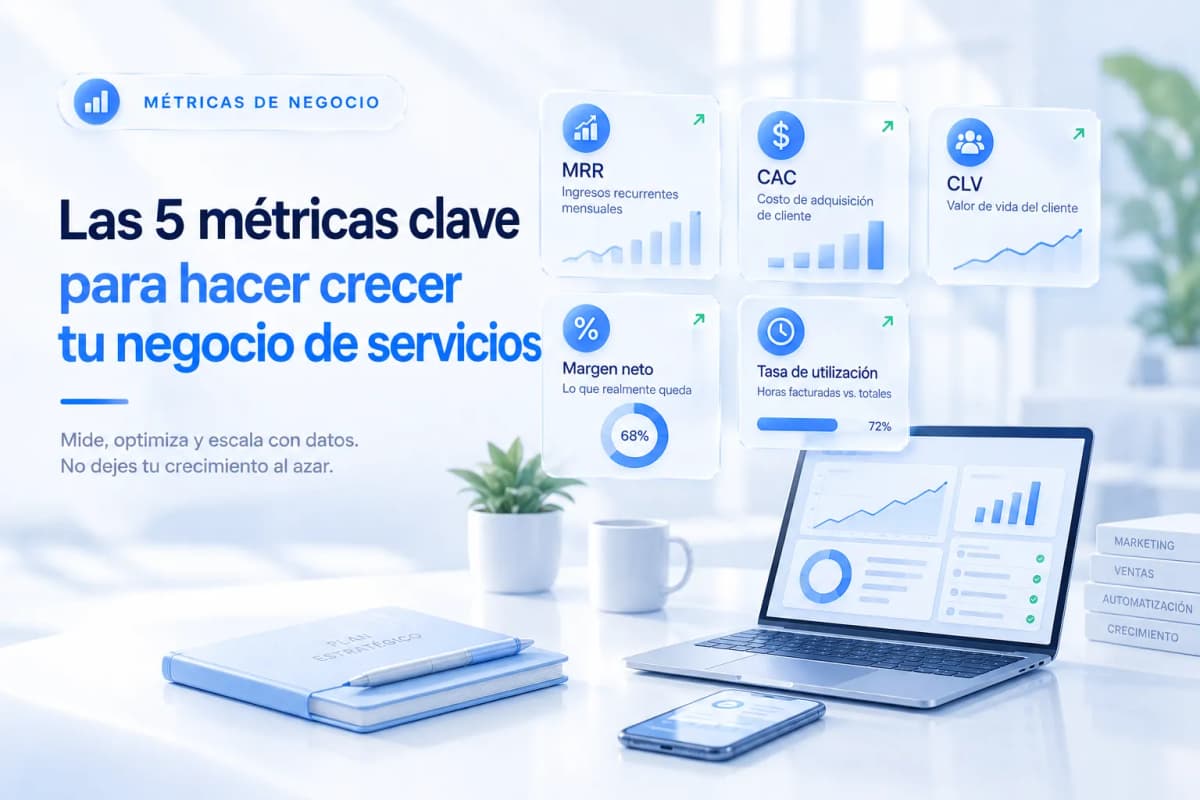
A healthy service business isn't managed with a single number. The five metrics below are read together: MRR signals stability, net margin signals efficiency, CAC measures the cost of growth, CLV measures the value of retention, and utilization rate measures whether available time is converting into money.
|
Metric |
What it measures |
Warning sign |
|---|---|---|
|
MRR |
Monthly recurring revenue |
Drops two months in a row |
|
Net margin |
% remaining after all costs |
Below 20% |
|
CAC |
Cost to acquire each new client |
More than 30% of first contract value |
|
CLV |
Total client value over time |
CLV:CAC ratio below 3:1 |
|
Utilization rate |
% of available hours that are billed |
Below 65% |
MRR — The Number That Turns Projects Into a Business
Definition: Monthly recurring revenue (MRR) is the sum of all predictable monthly income — primarily retainers, memberships, and ongoing service contracts. One-time projects don't count.
Formula: MRR = sum of all active monthly recurring payments
Benchmarks by vertical (LATAM, solo operator or small team):
|
Vertical |
Healthy starting MRR |
Consolidated MRR |
|---|---|---|
|
Coach / consultant |
$1,500–$4,000 USD/month |
$8,000–$20,000 USD/month |
|
Real estate agent |
Variable (commissions) |
Retainer model with investor clients |
|
Marketing agency |
$5,000–$15,000 USD/month |
$20,000–$50,000 USD/month |
Low or nonexistent MRR is the most common sign that a business lives off one-time projects — which creates unpredictable cash flow and makes planning nearly impossible. Moving even 50% of clients to a retainer stabilizes income without needing to find new clients every month.

CAC — What Each New Client Actually Costs You
Definition: Customer acquisition cost (CAC) is the total invested in marketing and sales during a period divided by the number of new clients acquired in that same period.
Formula: CAC = (Marketing spend + Sales costs) ÷ New clients acquired
Example: If in one month you spent $600 on Meta Ads, $200 on tools, and dedicated 10 hours of sales work (at $30/hour), your total investment was $1,100. If you acquired 4 new clients, your CAC is $275.
Click-to-WhatsApp ads reduce cost per lead by up to 40% compared to landing page funnels, per Meta for Business, because they eliminate friction and start the conversation where the lead is already active. That directly impacts CAC: fewer wasted leads in the process means lower cost per acquired client.
Warning sign: if your CAC exceeds 30% of the first contract value with that client, the acquisition economics aren't sustainable. A coach charging $1,500 for a program shouldn't be spending more than $450 to acquire each client.
CLV — How Much a Client Is Worth Over Time
Definition: Customer lifetime value (CLV) is the total revenue a client generates throughout their entire relationship with your business.
Formula: CLV = Average monthly ticket × Average retention in months
Example: A consulting client who pays $2,000/month and stays for an average of 8 months has a CLV of $16,000.
The ratio that really matters is CLV:CAC. If your CLV is $16,000 and your CAC is $800, the ratio is 20:1 — excellent. If your CLV is $2,000 and your CAC is $1,200, the ratio is 1.6:1 — the business loses money as it grows. The healthy baseline for service professionals is a minimum ratio of 3:1.
To improve CLV without lowering CAC, the most effective lever is retention. A ManyChat follow-up sequence that contacts clients every 30–60 days with relevant content, renewal offers, or results updates meaningfully reduces churn. Marketing automation reduces operational overhead by 12.2%, per Nucleus Research — and part of that savings goes directly into margin per retained client.

Net Margin — What Actually Stays
Definition: Net margin is the percentage of revenue that remains after deducting all operating costs — tools, advertising, subcontractors, taxes, platforms.
Formula: Net margin (%) = (Revenue – Total costs) ÷ Revenue × 100
Benchmarks:
|
Business type |
Healthy net margin |
|---|---|
|
Solo operator (coach, consultant) |
50–70% |
|
Small agency (2–5 people) |
20–35% |
|
Mid-size agency (5–15 people) |
15–25% |
Low net margin in a service business almost always has one of two causes: high acquisition costs (high CAC) or non-billable time consumed by administrative tasks. Automation addresses both: Meta Ads + ManyChat reduce CAC, and automated client communication flows recover hours that previously went to manual messages.
Utilization Rate — Available Hours vs. Billed Hours
Definition: Utilization rate measures what percentage of available working hours convert into billable work.
Formula: Utilization rate (%) = Billable hours worked ÷ Total available hours × 100
Example: If you work 160 hours per month and 100 are directly billable to clients, your utilization rate is 62.5%.
Benchmark: a healthy utilization rate for service professionals is between 65% and 80%. Below 65%, the business has unsold capacity. Above 85%, the professional is approaching burnout with no room to grow.
The main utilization thief isn't lack of clients — it's administrative time: answering repetitive questions, sending appointment reminders, chasing payments, coordinating schedules. Automating those tasks with ManyChat and HubSpot can recover 5–15 hours per month that convert directly into billable capacity.
Ready to Get More Clients?
At Asio, we teach you to implement these strategies step by step through the Mastery program — combining Meta Ads, ManyChat, and conversational automation so you get more appointments and close more sales, without relying on manual messages.