Back to Blog
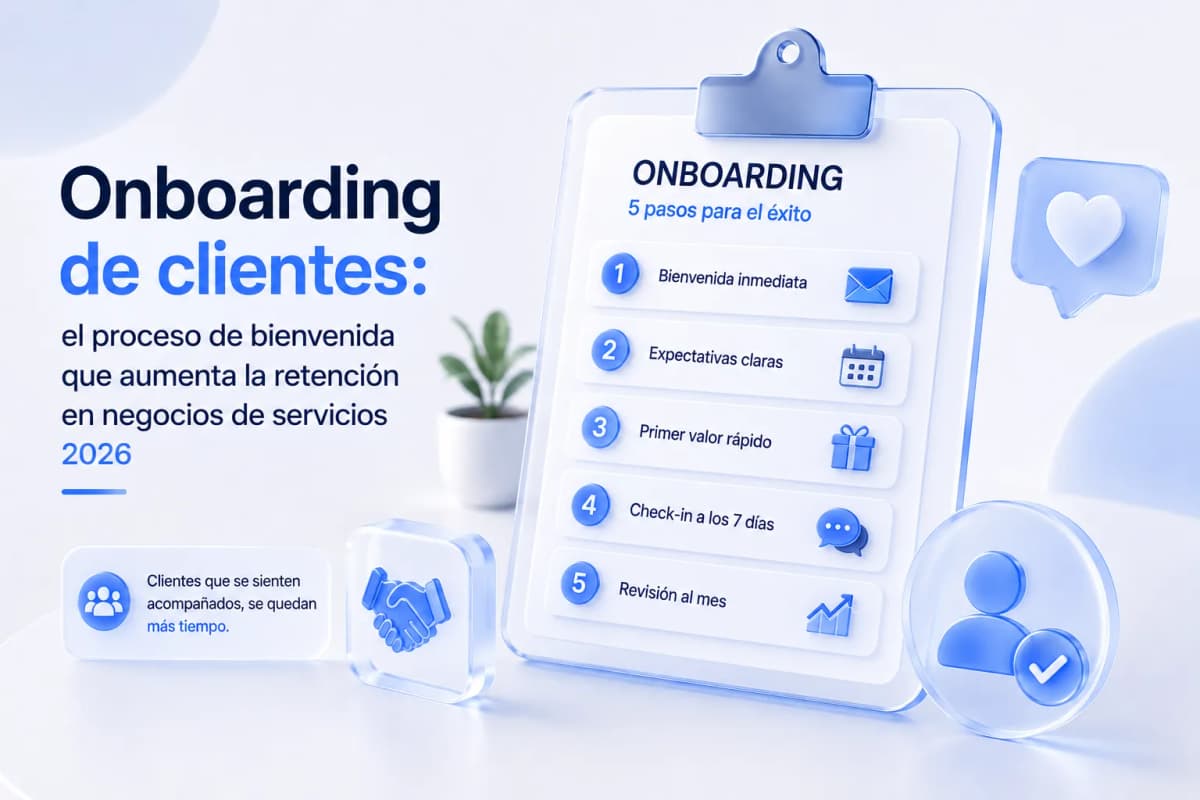
Onboarding Clients: The Welcome Process That Boosts Retention in Service Businesses 2026
Acquiring a client costs 5 to 7 times more than retaining one — and most service businesses lose clients not because of the service itself, but because of what happens (or doesn't happen) in the first 7 days after payment.
What Onboarding Is and Why Most Businesses Don't Have One
A client onboarding process is the structured sequence of communications and actions a new client receives from the moment they pay through their first tangible result. It's not just a welcome message — it's the bridge between the purchase decision and the confirmation that they made the right call.
Most coaches, consultants, and service businesses don't have a defined onboarding process. What they have is a generic welcome message followed by silence until the first session. That silence is where retention is lost: the new client, who just handed over money, starts questioning whether they made the right decision.
The expectation gap is the real problem. The provider assumes the client knows what to do next. The client assumes the provider will guide them. In that misunderstanding, most early-stage cancellations are born.
The 5 Steps of an Ideal Onboarding for Service Businesses
|
Step |
When |
What the business does |
Expected outcome |
|---|---|---|---|
|
1. Immediate welcome |
Within 2 hours of payment |
Personalized welcome message + one concrete next step |
Client feels they made the right decision |
|
2. Expectation setting |
Day 1 |
Send access links, intake form, first session scheduled |
Client knows exactly what will happen and when |
|
3. Quick first deliverable |
Day 3 |
A specific resource the client can use before the first session |
Client receives value before "the real work" starts |
|
4. Day 7 check-in |
Day 7 |
Follow-up message asking how the experience has been so far |
Client feels seen — business catches problems before they escalate |
|
5. Month 1 review |
Day 30 |
Review of results: what worked, what didn't, what's next |
Client feels progress — business identifies renewal or upsell opportunities |
Step 3 (quick first deliverable) is the most skipped and the highest-impact step for early retention. A client who receives value before the first session arrives more energized, better prepared, and with less anxiety about whether the investment was worth it.
WhatsApp Onboarding Sequence Template
This sequence can run manually (for businesses with fewer than 10 new clients per month) or be automated with ManyChat (for higher volumes). Messages are verbatim — adapt the fields in brackets:
Message 1 — Welcome (within 2 hours of payment)
"Hi [Name], welcome to [Program Name]!I'm [Your Name] and I'll be your direct point of contact throughout the whole process.In the next 24 hours I'll send you:
• Access to [platform / folder / materials]
• An intake form so I can personalize your experience
• The date and link for our first sessionIf anything comes up before then, this is the right place to reach me. Any questions right now?"
Message 2 — Expectation Setting (Day 1)
"Hi [Name], as promised, here's everything you need to get started:📎 Access: [link]
📋 Intake form: [link] — I'd ask you to complete this before our first session, it helps us make the most of our time together
📅 First session: [day] at [time] — [video call link]If that time doesn't work, let me know and we'll find another slot."
Message 3 — Quick First Deliverable (Day 3)
"Hi [Name], while we're getting to our first session, I'm sharing [resource name: guide, video, checklist] that gives you context on [specific topic].Link: [link]It's not required, but clients who go through it before the first session arrive with a much stronger foundation. Were you able to complete the intake form?"
Message 4 — Check-In (Day 7)
"Hi [Name], we're one week in. How has the experience been so far?I'm curious: was there anything that stood out as particularly useful, or anything that still isn't fully clear?Your feedback at this point helps me adjust the approach for the coming weeks."
Message 5 — Month 1 Review (Day 30)
"Hi [Name], we've hit the one-month mark.Before our next session, I wanted to ask three things:
✅ What was your most concrete result this month?
❓ What's still an obstacle?
💡 Is there anything about the process you'd change?This helps me make month 2 more effective than month 1."
ManyChat tags:
- Client responds positively to Day 7 → tag ONBOARDING_ACTIVE
- Client doesn't respond to Day 7 message → tag AT_RISK_CLIENT + team alert
- Client completes intake form → tag INTAKE_COMPLETED
- Client responds positively to Month 1 review → tag QUALIFIED_BOOKING for renewal conversation
The Mistakes That Destroy the First Impression
Mistake 1: Waiting more than 24 hours to send a welcome
Payment triggers an emotional window of 2–6 hours where the client is most receptive and enthusiastic. A welcome message that arrives 48 hours later reaches a client who has already started to second-guess the purchase.
Mistake 2: Assuming the client knows what to do next
"We'll be in touch soon" is not a next step. The client needs to know what they'll receive, when, and what's expected of them. Missing concrete instructions creates anxiety — and anxiety leads to cancellations.
Mistake 3: Sending everything at once
Sending all the access links, all the materials, all the forms, and all the context in a single message overwhelms the client. Phased onboarding (day 1, day 3, day 7) is designed to deliver information when the client can actually process it.
Mistake 4: Not confirming the first session
The client wrote down the date somewhere — or didn't. A reminder 24 hours before the first session reduces no-shows and signals organizational quality before the work even starts.
Mistake 5: Using the same message for everyone
"Hi, welcome to [program]" without mentioning the client's name, their situation, or what you agreed on in the closing call is the first signal that the service will be generic. Personalized onboarding starts with the intake form data — which is why the form goes in message 2, not at the end of the process.
Onboarding Metrics: The 30-Day Churn Rate as Your Primary KPI
The 30-day churn rate is the most revealing KPI for onboarding effectiveness. It measures how many clients cancel or go silent before completing the first month — and in most service businesses without a structured onboarding process, that number is higher than it appears.
The 3 metrics that matter:
|
Metric |
How to measure |
Target |
|---|---|---|
|
Month 1 churn rate |
Clients who cancel or go silent in the first 30 days / total new clients |
Under 10% |
|
Intake form completion rate |
% of clients who complete the intake form before the first session |
Over 80% |
|
Day 7 check-in response rate |
% of clients who respond to the Day 7 follow-up message |
Over 70% |
If the Day 7 check-in response rate is below 50%, the problem isn't the service — it's the onboarding. A client who doesn't respond isn't being difficult: they're either lost or starting to disengage.
Ready to Get More Clients?
At Asio, we teach you to implement these strategies step by step through the Mastery program — combining Meta Ads, ManyChat, and conversational automation so you get more appointments and close more sales, without relying on manual messages.