Back to Blog
Podcast Marketing for Coaches and Consultants in the US, Canada, and UK: A Practical Guide for 2026
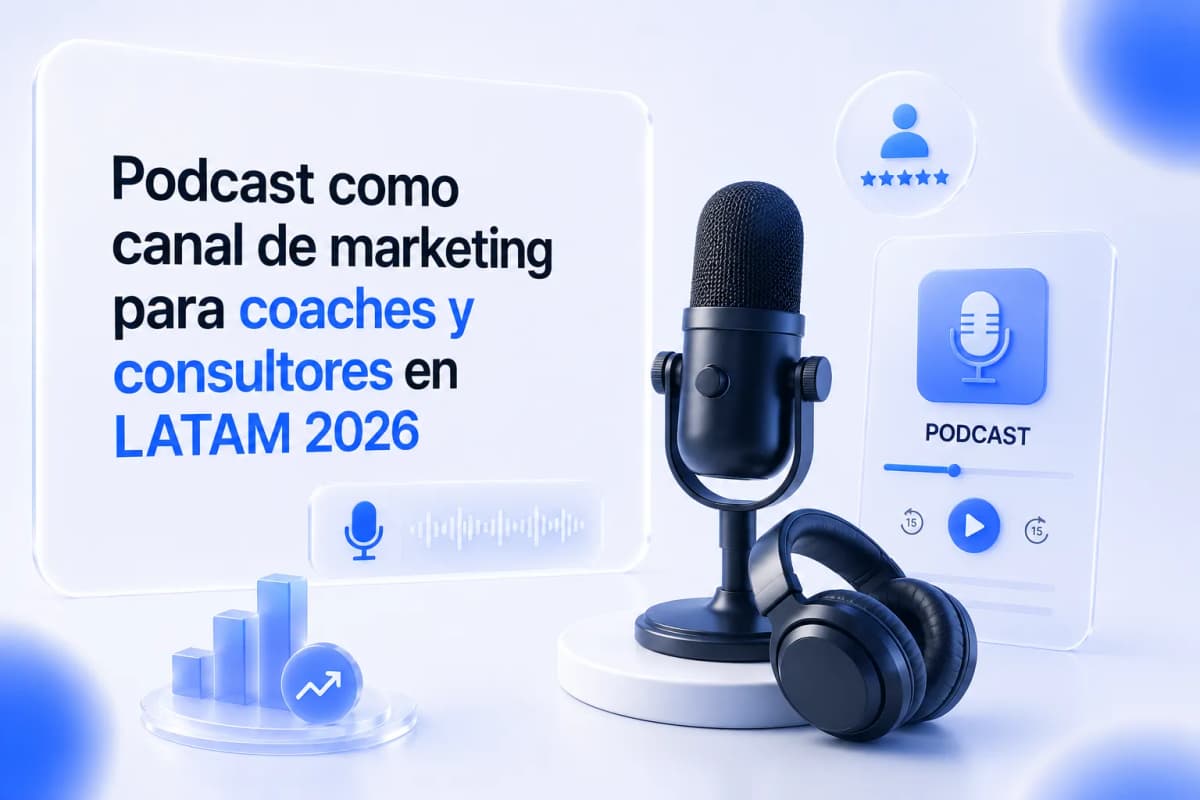
Whoever starts a podcast in their niche today still has a real first-mover advantage — most coaching and consulting categories in English still lack 2 or 3 dominant voices with a consistent program. Instagram is already saturated; podcasting offers a metric no Reel can match: listen time. Twenty minutes of audio creates a level of trust that takes weeks to build on social media.
Why Podcasting Builds Authority Faster for High-Ticket Services
The difference between podcasting and Instagram isn't about platform — it's about depth of relationship.
The average Reel is watched for 15-25 seconds. The average podcast episode is listened to for 20-40 minutes. When someone listens to 8 episodes of your show, they've spent over 3 hours with you — they've heard how you think, how you solve problems, how you respond to difficult questions. When that person books a consultation, they're not a cold lead. They've already decided to work with you and are confirming the fit.
That level of trust matters especially for high-ticket services ($1,500–$8,000+), where the decision cycle is long and the sales conversation works less hard because the authority is already established.
The market opportunity: even in English, most specific niches in coaching and consulting (leadership for first-time managers, financial planning for freelancers, sales systems for solo consultants, executive wellness) have fewer than 5 podcasts with real audience traction. Someone who starts now and stays consistent for 6 months has a high probability of becoming a recognized voice in that niche.
How to Start without Equipment or Budget
The biggest perceived barrier to starting a podcast is the technical setup. The real setup for a first episode at acceptable quality:
|
Equipment |
Minimum option |
Approximate cost |
|---|---|---|
|
Microphone |
Lavalier (lapel) microphone for smartphone |
$20 – $50 USD |
|
Headphones |
Any headphones with built-in mic (alternative to lavalier) |
$15 – $30 USD |
|
Recording |
Native smartphone recorder or GarageBand / Voice Recorder app |
Free |
|
Basic editing |
Audacity (desktop, free) or GarageBand (iOS, free) |
Free |
|
Distribution |
Spotify for Podcasters |
Free |
Spotify for Podcasters automatically distributes to Apple Podcasts, Amazon Music, Deezer, and other platforms from a single upload. No developer account or complex technical configuration needed — upload the audio file, complete the episode description, and within 24-48 hours it's live across the major platforms.
Production quality matters less than it appears in the first months. Podcast listeners are far more tolerant of imperfect audio than of content without value. A lapel mic in a quiet room produces perfectly acceptable audio for the first 50-100 episodes.
The 3 Formats That Work for Service Businesses
1. Solo educational
You as the only speaker. You structure the episode as a class or talk on a specific topic in your niche. It's the format that builds the most personal authority because the listener hears you think, argue, and solve — without the mediation of another voice.
When to use it: when you want to establish yourself as the go-to voice on a specific topic. Ideal for early episodes before you have contacts to interview.
2. Interviews with ideal clients
You invite people who represent your ideal client — not necessarily well-known figures, but someone whose story or perspective resonates with the audience you want to attract. The guest provides credibility and perspective; you demonstrate your ability to ask the right questions.
When to use it: when you have relationships with people who can speak to the problems you solve. Also generates distribution content — guests share the episode with their network.
3. Own case studies
You describe a process you applied with a client (with or without revealing their identity) or in your own business: the initial problem, the decisions you made, the results achieved, and the lessons learned. It's the format with the highest conversion potential because it demonstrates concrete results, not just theoretical knowledge.
When to use it: when you have specific results to show. It's the hardest format to fake — which is what makes it most credible.
How to Monetize Indirectly: The Podcast as a Funnel
Podcasting doesn't monetize directly (advertising, sponsorships) until you reach thousands of listeners per episode. The practical monetization for a coach or consultant with a new show is indirect: the episode as a funnel entry point.
The cycle that works:
- Episode with real value — the listener learns something actionable in 20-30 minutes
- CTA at the end of the episode — "If you want to apply this to your specific situation, book a free 30-minute session with me" + direct link
- Free consultation call — where the listener arrives pre-qualified (they've listened to 3-8 episodes, they already know how you work, they already trust you)
- Service offer — conversion is higher because the trust objection is already resolved
How to structure the CTA at the end of each episode:
"That was [one-line summary of the episode]. If you're in [situation the listener recognizes] and want [specific outcome], you can book a free 30-minute diagnostic session with me — the link is in the episode description. On that call we review your specific situation and I tell you exactly what I'd do in your position."
The CTA needs to be specific and propose a concrete action — not "follow me on social media," not "visit my website." A free consultation with a date and a direct link.
Distribution without Extra Work: 1 Episode → 5 Content Pieces
|
Format |
How it's generated |
Platform |
Extra time |
|---|---|---|---|
|
Full episode |
Original recording |
Spotify, Apple Podcasts, Amazon |
— |
|
60-90 second clip |
Cut the strongest moment with CapCut |
Instagram Reels, TikTok, YouTube Shorts |
15-20 min |
|
Transcript + article |
Paste audio into Whisper (OpenAI, free) → edit in ChatGPT |
Blog / LinkedIn article |
20-30 min |
|
3 quote graphics |
Extract 3 lines from transcript + design in Canva |
LinkedIn, Instagram Stories |
10-15 min |
|
Newsletter |
Episode summary in 250-300 words |
Email list |
15 min |
Total content from 1 recording: 1 episode + 3-5 Reels/Shorts + 1 blog article + 3 posts + 1 newsletter. Total distribution time is 60-80 minutes once you have the workflow set up.
First 8-Episode Plan
|
Episode |
Topic |
Format |
Goal |
|---|---|---|---|
|
1 |
Why I started this podcast and what you can expect |
Solo |
Set expectations and establish who you are |
|
2 |
The most common mistake I see in [niche] |
Solo |
Hook audience with a recognizable problem |
|
3 |
Case study: how [client] went from X to Y |
Case study |
Demonstrate results |
|
4 |
Interview: [someone in your network who embodies your ideal client] |
Interview |
Social proof, distribution |
|
5 |
The exact process I use with clients to achieve [result] |
Solo |
Technical authority + implicit funnel |
|
6 |
Frequently asked questions about [niche topic] |
Solo |
Audio SEO, capture searches |
|
7 |
Case study: the mistake I made and what I learned |
Case study |
Credibility through vulnerability |
|
8 |
Recap: the 5 most important ideas from these first months |
Solo |
Recapitulation + invite new audience |
Recommended frequency: 1 episode per week, 20-35 minutes in length. For the first 3 months, consistency matters more than production perfection. A good episode published on time beats a perfect episode that ships two weeks late.
Ready to Get More Clients?
At Asio, we teach you to implement these strategies step by step through the Mastery program — combining Meta Ads and conversational automation so you get more appointments and close more sales, without relying on manual messages.