Back to Blog
Creating a Proposal that Closes: Template and Process for Coaches and Consultants in 2026
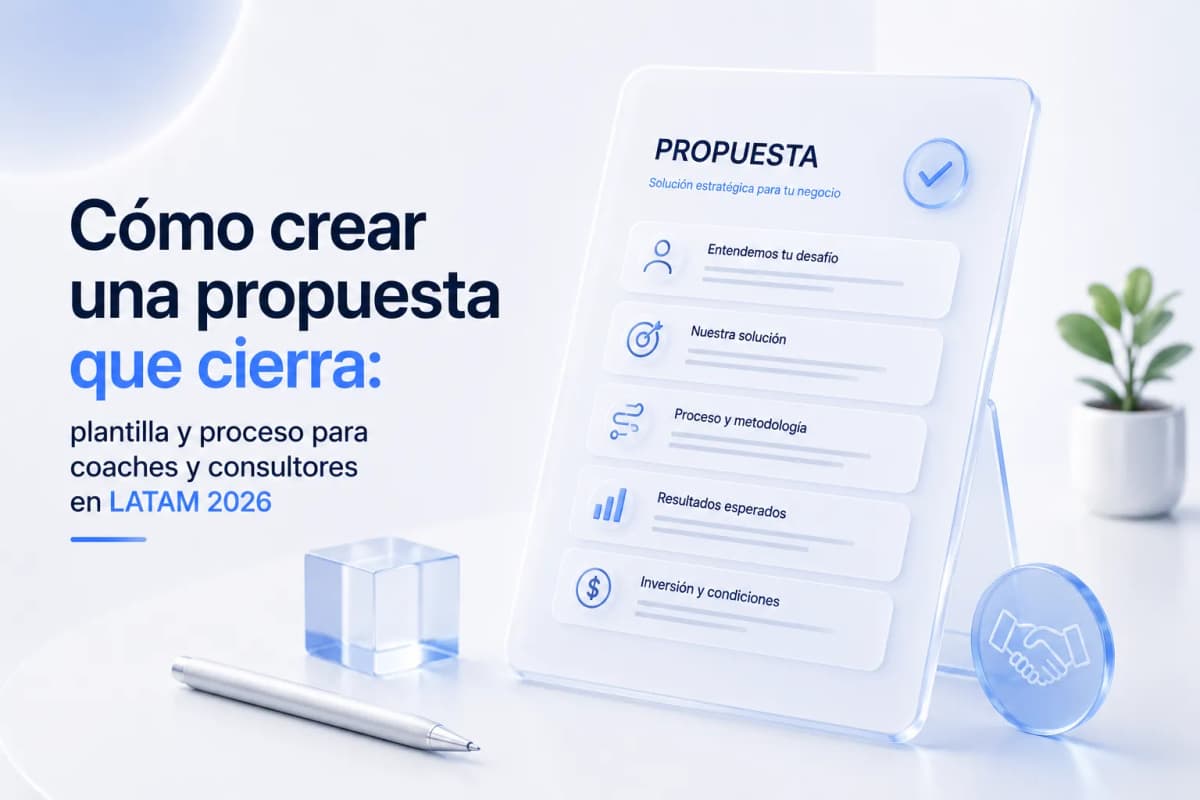
The proposal reaches the client at the moment they've already made a preliminary decision — what it can do is confirm that decision or destroy it. Most coaches and consultants destroy theirs by sending a 15-page PDF the client closes without reading.
Why the Long Proposal Converts Less
The logic seems reasonable: more detail = more confidence. In practice, it works in reverse. A long proposal forces the client to do work — read, evaluate, compare — at a moment when they're not yet committed. The result is procrastination, and procrastination in sales is synonymous with "no."
The short, well-structured proposal eliminates that friction. The client can read it in 3 minutes, understand exactly what they're buying, and make a decision. What converts is not the volume of information — it's clarity.
The most common mistake: the proposal is used to convince the client to hire you. But if the client needs to be convinced in the proposal, the sale already failed — in the discovery call. The proposal should only confirm what you already agreed on in that conversation.
The 5 Elements That Must Be in Every Proposal
A proposal that closes has exactly 5 components. No more, no less:
|
Element |
What it includes |
Why it matters |
|---|---|---|
|
1. The client's specific problem |
Their current situation described in their words — not yours |
Proves you listened in the discovery call |
|
2. Your concrete solution |
What you'll do — without jargon, without "holistic approach" — what the client will receive |
Clarity on the deliverable |
|
3. The process or methodology |
3–5 concrete steps with real names (not "session 1," "session 2") |
Reduces perceived risk — the client knows what will happen |
|
4. Expected results with metrics |
Not "improve your marketing" — yes "generate 10 qualified leads per month in 60 days" |
Makes ROI tangible before the close |
|
5. Investment and terms |
Price, payment structure, duration, and what happens if the client wants to cancel |
Eliminates the questions that postpone the decision |
Element 1 is the most important and the most ignored. A consultant who opens the proposal with "Our firm was founded in 2015 and has 8 years of experience…" has already lost the client's attention by the second paragraph.
What Should NOT Be in Your Proposal
This list matters as much as the one above:
- Your story and background: the client already chose you for the call. They don't need your bio. If they ask for it, send it separately — don't put it in the proposal.
- Your company's history: same as above. The proposal is about the client, not you.
- Your full portfolio: if the client wants to see past case studies, it's a signal they're not fully convinced. That gets resolved in the discovery call — in the proposal, include at most one relevant case as a reference.
- Paragraphs that start with "I" or "we": every paragraph in the proposal should be able to start with "you" or "your business." If it can't, rewrite it.
- Extended legal terms and conditions: if you need legal protection, use a separate contract. The proposal closes; the contract formalizes.
One-Page Proposal Template
This structure works for coaches and consultants selling services from $1,000 to $15,000 USD. Everything on one page or under 500 words:
[Client Name] / [Date]
The challenge:
[2–3 sentences describing the specific problem the client mentioned in the call. Use the client's words, not technical terminology.]
What we're going to do:
[One sentence with the concrete solution.]
- Step 1: [Step name + what happens in it]
- Step 2: [Step name + what happens in it]
- Step 3: [Step name + what happens in it]
What you'll have when we're done:
- [Specific result with a number: e.g., "lead generation system producing X qualified leads/month"]
- [Specific result: e.g., "documented process your team can run without you"]
- [Specific result: e.g., "first campaign live with results within 30 days"]
Investment:
[Total price or per month] — [Payment structure: 50% upfront / 50% on completion, or monthly, etc.]
Duration: [X weeks/months]
Next steps:
To move forward, I need [X] to reserve your start slot for [proposed start date]. We can begin on [specific date].
The "Next steps" field is the most omitted and the highest impact. It gives the client a concrete action instead of leaving them floating with "I'll think about it."
How to Present the Proposal: Video Call First, Email as a Backup
Video calls convert more than email for one simple reason: on a video call you can read the client's reactions in real time. If they wince at the price, you see it and can ask. If they say "let me think about it," you can ask "what specifically do you need to think through?" In email, that's not possible — the client disappears and you don't know why.
The recommended protocol:
- At the end of the discovery call: "I'll send you the proposal within the next 24 hours. When can we review it together?"
- Schedule a 30-minute review call for 48 hours later
- Send the proposal 24 hours before that call (not the night before at 11 pm)
- In the review call: "Did you get a chance to read it? Any questions before we talk about next steps?"
If the client can't or won't do a review call, send the proposal anyway — but lower your close-rate expectation. A proposal sent by email without a presentation meeting has a significantly lower conversion rate.
The Timing: The 24 Hours After the Call
The momentum window after a sales call lasts between 24 and 48 hours. During that window the client is more likely to commit because the conversation is fresh and the urgency of solving their problem is too.
Every hour that passes after those 24 hours means:
- The client returns to their daily operations and the problem loses urgency
- Other priorities compete with your proposal for their attention
- The personal connection from the call cools down
Rule: if you haven't sent the proposal within 24 hours of the call, you're competing against forgetting.
The 3-Touch Follow-Up in 7 Days
Follow-up is where most coaches and consultants either give up — or come across as desperate. The mistake is repeating the same question ("did you get a chance to look at it?") every two days.
The 3-touch follow-up in 7 days works because each touch has a distinct purpose:
Touch 1 — Day 1 (when you send it)
"Hi [Name], I just sent over the proposal. Let me know if you have any questions or want me to go deeper on anything."
Purpose: acknowledge delivery, keep the door open without pressure.
Touch 2 — Day 3 (add value)
"Hi [Name], I wanted to share a quick case study of [generic client type] who was in a similar situation — might be useful to see how the process played out. [Link or attached PDF]"
Purpose: add value without asking about the decision. Shows confidence — you're not chasing, you're contributing.
Touch 3 — Day 7 (close the loop)
"Hi [Name], I want to make sure we're aligned on next steps. Do you have a timeline in mind for making a decision, or is there something specific you need to move forward?"
Purpose: this question gives you real information. If the client says "I need to check whether the budget clears next month," you have a close in sight. If they don't respond, you know the opportunity is cold — and you can move on instead of continuing to invest time.
After touch 3: if no response, send one final message 30 days later with a value touchpoint. If still no response, archive the contact as COLD_PROSPECT and activate a long-term nurturing sequence.
Which Tool to Use Based on Client Type
There's no single tool that works for every client. The choice depends on the client's profile:
|
Tool |
Best for |
Why |
|---|---|---|
|
Notion |
Tech clients, startups, digital freelancers |
Interactive page with links, images, and structure — can be updated in real time |
|
Canva |
Coaches, visual clients, small business owners |
High visual impact, easy to create and send as PDF — projects professionalism without technical design skills |
|
Google Slides |
Corporate clients, traditional businesses, executives |
Familiar format, opens on any device, no special account needed to view |
|
Word/Google Docs |
B2B consultants, law firms, accountants |
Formal format expected in those sectors — don't try to impress with design a client who wants sobriety |
General rule: if you're unsure which tool to use, Canva as a PDF is the safest option for the client range most coaches and consultants serve.
Ready to Get More Clients?
At Asio, we teach you to implement these strategies step by step through the Mastery program — combining Meta Ads, ManyChat, and conversational automation so you get more appointments and close more sales, without relying on manual messages.