Back to Blog
Social Proof That Converts: How to Get and Showcase Testimonials in Your Service Business in 2026
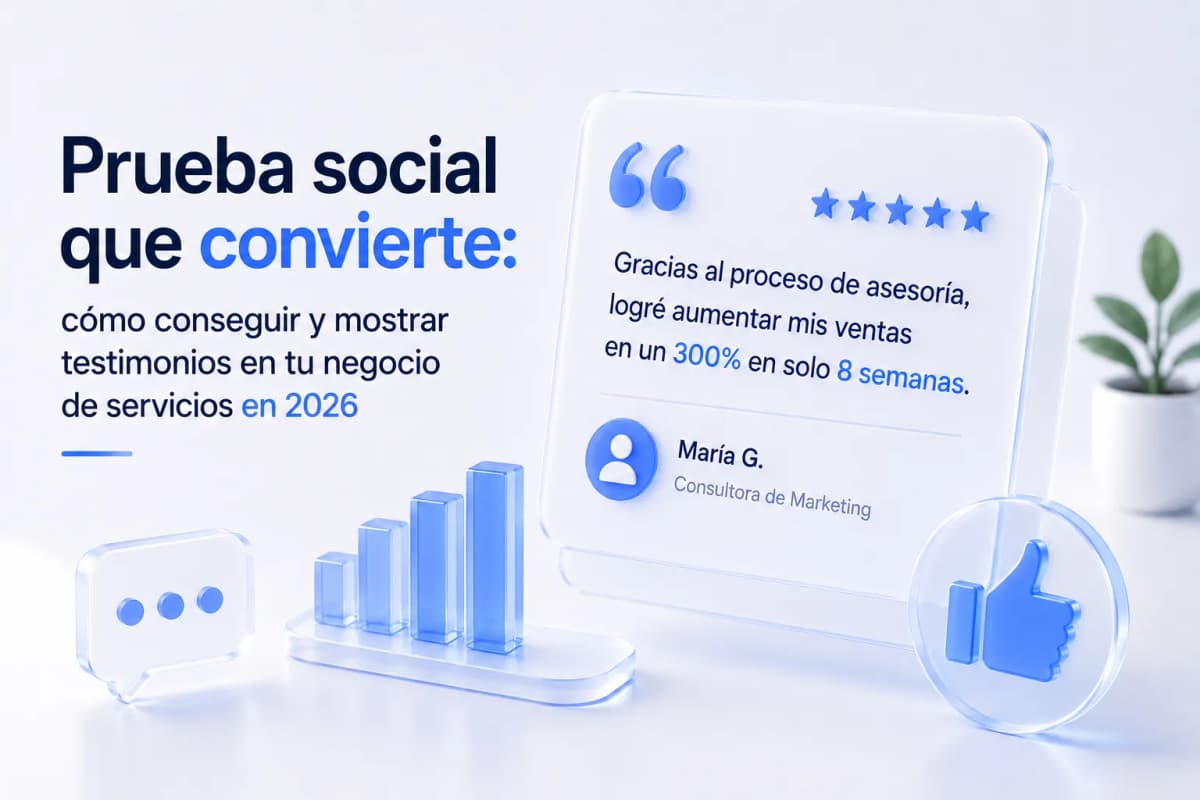
One well-asked testimonial can outperform ten pieces of content — but most service professionals in the US, Canada, and UK don't know when to ask for it, how to ask for it, or where to put it so it actually drives decisions.
Why Generic Testimonials Don't Convert
"Great service, highly recommend!" — that testimonial doesn't convert. Not because it's false, but because it gives a prospective client nothing concrete to act on.
The prospect evaluating whether to hire a coach, a consultant, or a dentist isn't looking for validation. They're looking for evidence that someone with their specific problem got the result they want. That requires specificity.
Compare these two testimonials from the same client:
|
Generic testimonial |
Specific testimonial |
|---|---|
|
"Great service, very professional" |
"Before working with [name], I'd been trying to grow my practice for 18 months without consistent results. In 6 weeks I booked 3 new clients using the system they taught me. I'd recommend this to any independent consultant who wants predictable client acquisition" |
The second one converts. The first is noise. The difference isn't the client — it's the questions you asked.
The Exact Moment to Ask for a Testimonial
The worst time to ask for a testimonial is at the end of the engagement, when the relationship is winding down. By that point, the client is no longer in the emotional state of experiencing the result — and the quality of what they give you reflects that.
The right moment is immediately after the client experiences the result, while the emotion is still active:
- For a coach: right after the client closes their first sale using the method
- For a dentist: as the patient is checking out, when the discomfort is gone
- For a consultant: when the client sees the first numbers from the project
- For a real estate agent: on signing day
A testimonial captured at that moment includes emotion and detail you won't recover later. Waiting converts a vivid experience into a vague memory.
The 3 Questions That Generate the Best Testimonials
The gap between a testimonial that converts and one that doesn't almost always comes down to the questions you asked. These three questions extract exactly what a prospective client needs to make a buying decision:
|
Question |
Why it works |
Example answer |
|---|---|---|
|
What was your situation or problem before we started? |
Creates recognition in the prospect — "that was me" |
"I'd been relying entirely on referrals for two years with no predictable pipeline" |
|
What specific result did you get? |
Converts the experience into measurable evidence |
"In 5 weeks I generated 4 inbound inquiries and closed 2 contracts" |
|
Who would you recommend this to, and why? |
Defines the ideal client + creates implicit endorsement |
"Any independent consultant who wants clients without depending on someone else recommending them" |
These three questions aren't a checklist — they're a narrative arc. They start with the client's problem (which the prospect recognizes), move to the concrete result (which the prospect wants), and end with a qualified recommendation (which confirms the service is right for someone like them).
Format Matters: Video > Audio > Written Text
Not all testimonials carry the same credibility weight. The format determines how much a prospect trusts what they're seeing:
Video (highest credibility): the prospect sees the face, hears the tone, reads the micro-expressions of the client. Very difficult to fabricate — which is exactly why it builds the most trust. A 60–90 second video shot on the client's phone converts more than any professionally produced written piece.
Audio (medium-high credibility): voice communicates emotion even without image. A voice note or short audio clip works well in Instagram Stories or embedded in a landing page when the client prefers not to appear on camera.
Written with photo (medium credibility): still effective on landing pages, Google Business Profile, and LinkedIn, particularly when it includes name, role or industry, city, and photo. Without a photo, written text carries less weight — any prospect knows an unattributed quote is easy to fabricate.
How to ask for a video in a DM or text:
"Hey [Name], would you mind recording a quick 60-second video on your phone? Just telling other [coaches/consultants/clients] what the situation was before we worked together and what changed. Doesn't have to be polished at all — informal is actually better. If a voice note is easier, that works too."
Giving options (video or voice note) increases the likelihood of getting a response. Specifying that it doesn't need to be polished removes the production barrier that stops most clients from responding.

Where to Showcase Social Proof So It Actually Converts
Having testimonials isn't enough — where you place them determines whether they drive decisions.
Landing page — above the CTA: the highest-impact placement. The visitor who arrives with interest but still has doubts needs to see evidence right before clicking the booking or contact button. A specific video testimonial or a written result above the CTA can meaningfully increase button conversion.
Instagram Highlights — "Results": a permanent Highlight with video testimonials or screenshot messages from clients functions as passive social proof. A prospect who finds your profile after watching a Reel will check your Highlights — it's one of the first places they assess whether you're credible.
Google Business Profile — active reviews: Google reviews carry different weight than testimonials you control — the prospect knows you can't edit them. Asking clients to leave a Google review (not just send you a DM) adds external credibility that your own page can't manufacture.
LinkedIn recommendations (for B2B services): for consultants, coaches, and agency owners serving business clients, a LinkedIn recommendation from a recognizable professional carries weight that Instagram testimonials can't replicate. These belong on your profile and can be embedded in proposals.
The Case Study as a Premium Social Proof Format
For high-ticket services — coaching, consulting, agencies — a case study outperforms a single testimonial because it shows the process, not just the outcome. A prospect considering a $3,000–$10,000 investment isn't moved by a positive paragraph; they're moved by understanding exactly what happened and why it worked.
Effective case study structure:
- Initial situation: who the client was, what problem they had, what they'd tried before without results
- The decision: why they chose to work with you, what convinced them
- The process: what you worked on together, in what order, over what timeframe
- The result: specific number, measurable change, current situation
This can be a 2-page PDF, a 6-slide Instagram carousel, a LinkedIn article, or a 3–5 minute video. The channel matters less than the specificity of the content.
Best suited for: business consulting, high-ticket coaching, marketing agencies, transformation services with measurable results over weeks or months.
How to Ask for Permission and Use the Client's Story Without Compromising Privacy
Before publishing any testimonial, you need two things: the testimonial itself and explicit permission to use it. A client who discovers you shared their story without asking can damage the relationship in a way that negates the value of the testimonial entirely.
What to ask for permission:
- Can I share what you told me on my website / social media / sales presentations?
- Would you prefer to appear with your full name, first name only, or anonymously?
- Is there any information you'd rather not include (company name, specific numbers, city)?
Anonymization options: if the client prefers privacy but gives permission to use their story, you can publish the testimonial as "M., independent business coach, Toronto" or "Senior consultant, financial services, Chicago" — enough context for a prospect to identify with the profile, without exposing personal details.
WhatsApp and DM Script for Requesting a Testimonial
This script works in three short messages — one long block doesn't get read; three conversational messages do:
Message 1 (right after the result):
"Hey [Name], so great to hear [specific result they mentioned]! Really happy for you. Quick question if you have a second 🙏"
Message 2 (the 3 questions):
Message 3 (permission + format options):
"And before I use it anywhere I'll check with you on how you'd like to appear — full name, first name only, or anonymous. Your call. Thanks so much either way!"
This script works because it's conversational rather than form-like, gives format options (voice note or text), and integrates the permission request into the same natural exchange without making it feel like a separate bureaucratic step.
Ready to Get More Clients?
At Asio, we teach you to implement these strategies step by step through the Mastery program — combining Meta Ads, ManyChat, and conversational automation so you get more appointments and close more sales, without relying on manual messages.