Back to Blog
Creating a Sales SOP for Your Insurance Team: The Manual That Boosts Production
The most common bottleneck in insurance agencies with 3–20 agents isn't a lack of leads — it's that all the knowledge lives in the leader's head. When the leader is unavailable, production drops. When a new agent joins, it takes 3–6 months to reach the leader's conversion rate. A sales SOP converts that institutional knowledge into a repeatable process any agent can follow from day one.
Why Most Agencies Are Stuck Depending on the Leader
The typical sequence in an agency without a SOP:
- A lead comes in → the leader decides how to respond (or responds themselves)
- A new agent tries to follow the leader's example without clear instructions
- Clients receive inconsistent responses depending on which agent handled them
- The leader reviews and corrects → becomes the bottleneck for every step
The result: the agency can't grow beyond the leader's personal capacity, and hiring more agents creates more chaos than production.
A SOP breaks that dependency by documenting exactly what to do, when, with which tool, and within what time frame — so the team can execute with the same quality as the leader, without needing the leader at every step.
The 5 Processes That MUST Have a SOP First
Not every agency process requires immediate documentation. These 5 generate the highest production impact when standardized:
|
# |
Process |
Why it's critical |
|---|---|---|
|
1 |
Lead management in the first 5 minutes |
The first responder wins the sale. Without a SOP, response time depends on who's available |
|
2 |
Prospecting script |
Without a script, every agent improvises and results are inconsistent. With one, a new agent can produce from week one |
|
3 |
Qualification process |
Defines exactly which questions determine whether a lead is worth pursuing. Prevents agents from spending hours with prospects who will never buy |
|
4 |
Quote follow-up |
Most closes happen on the 3rd or 4th contact. Without a follow-up SOP, agents give up too early |
|
5 |
Renewals and reactivations |
Existing clients are 5–7x more likely to buy than new prospects. Without a SOP, renewals only happen when the agent remembers |
SOP Template: Lead Management in the First 5 Minutes
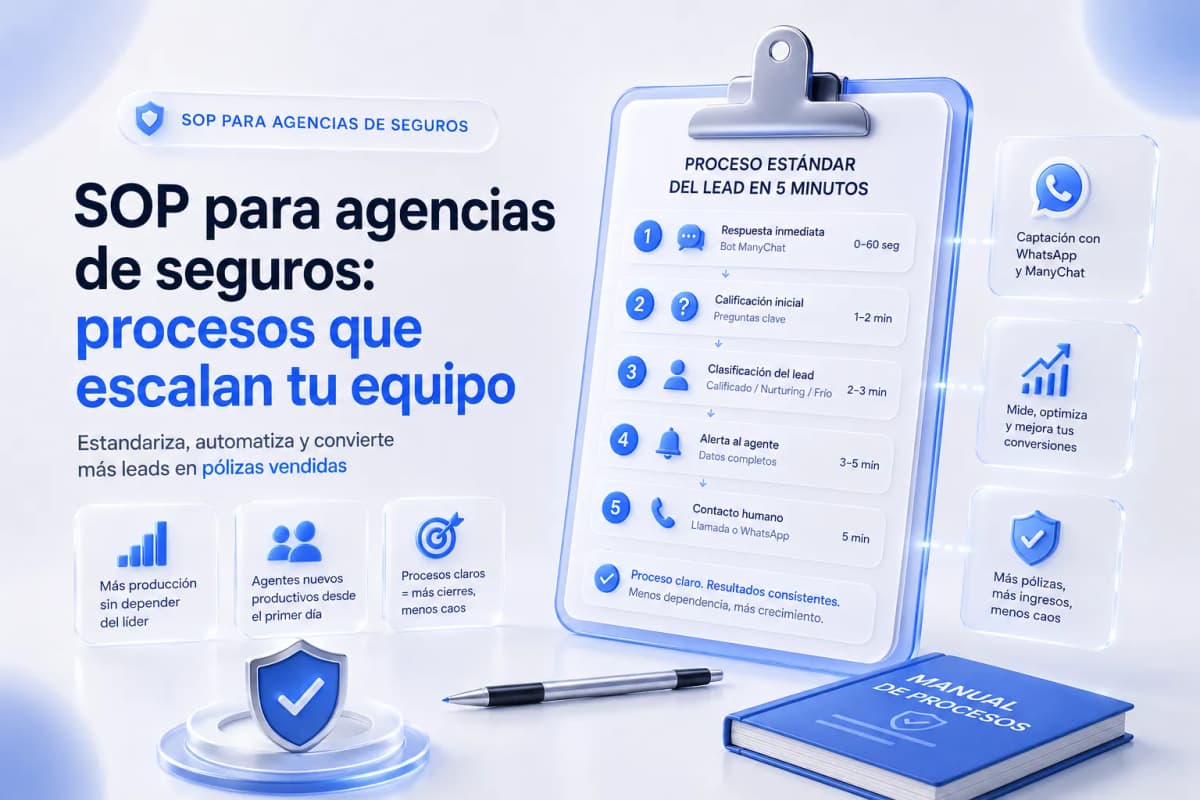
This is the most critical process in any insurance agency. A lead that doesn't receive a response within 5 minutes loses interest and moves to a competitor. The full template:
|
Step |
Time |
Owner |
Tool |
Specific action |
|---|---|---|---|---|
|
1 |
0–60 sec |
ManyChat bot |
ManyChat + WhatsApp/SMS |
Automatic welcome message + first question: "How many people are you looking to insure?" |
|
2 |
1–2 min |
ManyChat bot |
ManyChat |
Second question: "What type of insurance are you looking for? (life / health / auto / other)" |
|
3 |
2–3 min |
ManyChat bot |
ManyChat |
Qualified → alert agent with full lead data. Not qualified → enter nurture sequence |
|
4 |
3–5 min |
Assigned agent |
WhatsApp / Phone |
Agent receives alert + lead data + opens prospecting script |
|
5 |
5 min |
Assigned agent |
Call / Text |
First human contact using standardized script |
ManyChat tags by qualification result:
- Lead responded + complete profile → QUALIFIED_BOOKING
- Lead responded but needs more information → NURTURING_21D
- Lead didn't respond within 30 minutes → COLD_PROSPECT + automatic retry in 2 hours
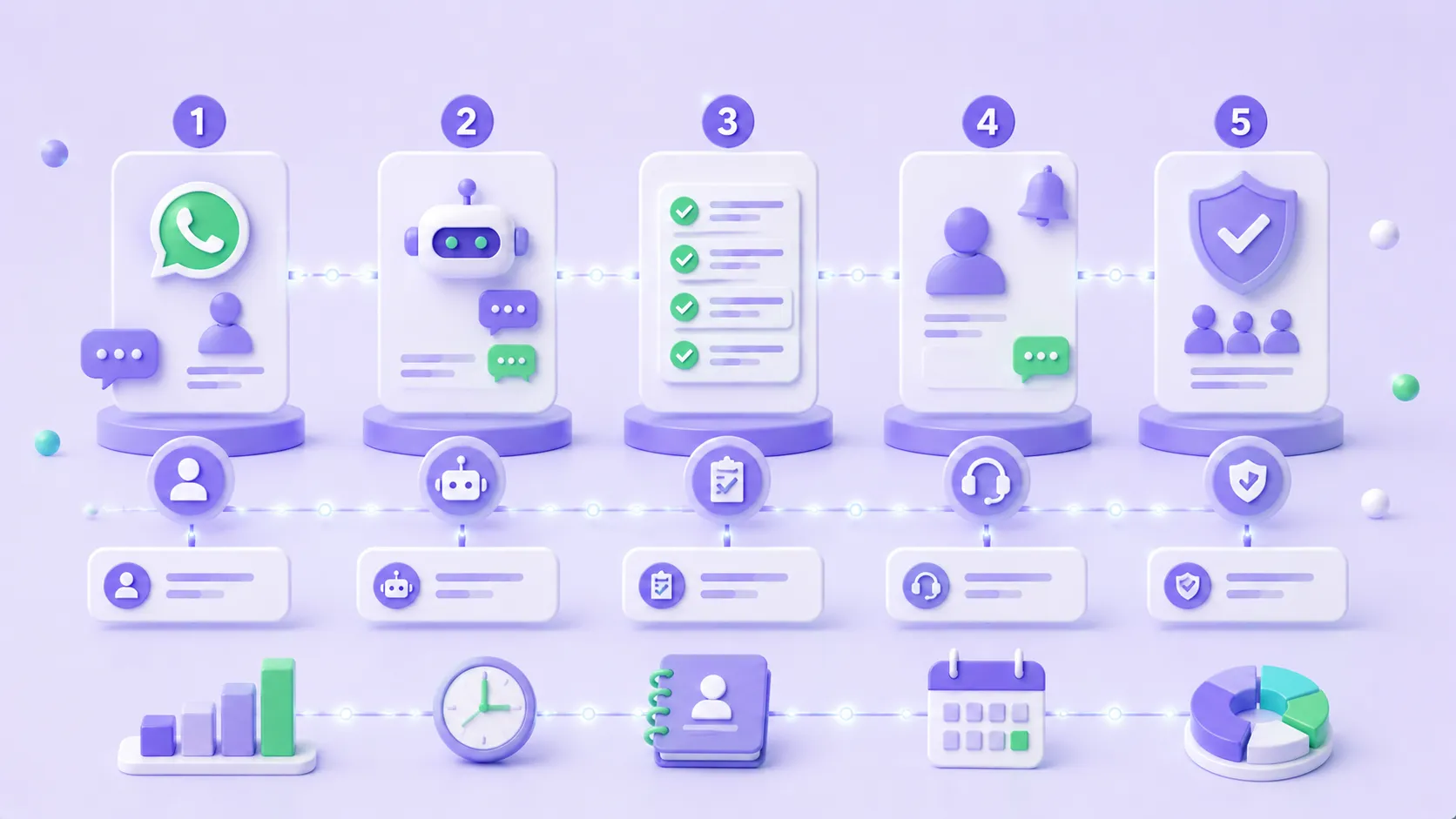
Agent Opening Script (Steps 4–5)
"Hi [name], this is [your name] from [agency name]. I saw you were looking for [type of insurance they selected]. I'm reaching out to understand your situation better and see if we can help. Do you have 5 minutes right now?"
If call goes to voicemail:
"Hi [name], this is [your name] from [agency]. I tried to reach you about your [insurance type] inquiry. Is there a good time today for a quick 5-minute call?"
How to Write a SOP That Actually Gets Used
The problem with most process manuals is format: 20-page documents with dense paragraphs that nobody reads after the first day.
A SOP that gets used has these characteristics:
Visual format, not narrative:
❌ "The agent should verify the prospect's availability before proceeding with the offer presentation, ensuring the timing is appropriate and the prospect has sufficient time..."
✅ Step 3: Verify availability (30 seconds)
"Do you have 5 minutes right now?"
- Yes → continue to step 4
- No → "What's the best time to reach you today?" → schedule and log in CRM
One page per process: the lead management SOP should fit on a single printed page. If it doesn't, it's too long.
Verbatim scripts: not "ask a qualifying question" but exactly what to say, word for word. New agents don't improvise well — they need the exact text until they internalize it.
Quick-reference card: alongside the full SOP, create a single-sheet card with numbered steps and the main scripts. Agents use it for the first 30 days until the process becomes automatic.
How to Implement With the Team Without Resistance
Even the most complete SOP fails if the team doesn't adopt it. The 3 most common causes of resistance and how to address them:
"The leader wrote it without asking us": involve the 2–3 top-performing agents in writing the SOP. They know what actually works in practice. This also creates co-ownership of the process.
"It's too rigid for real situations": the SOP covers the standard process (80% of cases). For the 20% of exceptions, the agent has autonomy. Document this explicitly: "If the prospect says X, the agent chooses Y or Z based on judgment."
"We don't have time to learn it": the SOP isn't taught in a training session. It's practiced through role-play: the leader plays the prospect, the agent runs the SOP in real time, corrections happen in the moment. First 2 weeks: 10-minute daily role-play. After: weekly role-play.
How to Integrate the SOP with ManyChat
Integrating the SOP with automation means the bot executes steps 1–3 perfectly and consistently — without forgetting, without fatigue, in under 2 minutes. When the agent receives the alert, the lead is already qualified and all context is already captured.
The ManyChat bot follows the same SOP as the agent — the same questions, the same order, the same qualification criteria — with the difference that it handles all incoming leads simultaneously, including nights and weekends.
What the bot does NOT replace: the human call in step 5. Closing insurance requires trust, and trust requires a human voice. The SOP defines exactly where the bot ends and the agent begins.
Ready to Get More Clients?
At Asio, we teach you to implement these strategies step by step through the Mastery program — combining Meta Ads, ManyChat, and conversational automation so you get more appointments and close more sales, without relying on manual messages.