Back to Blog
Digital Marketing for Architects and Interior Designers: How to Attract High-Value Clients in 2026
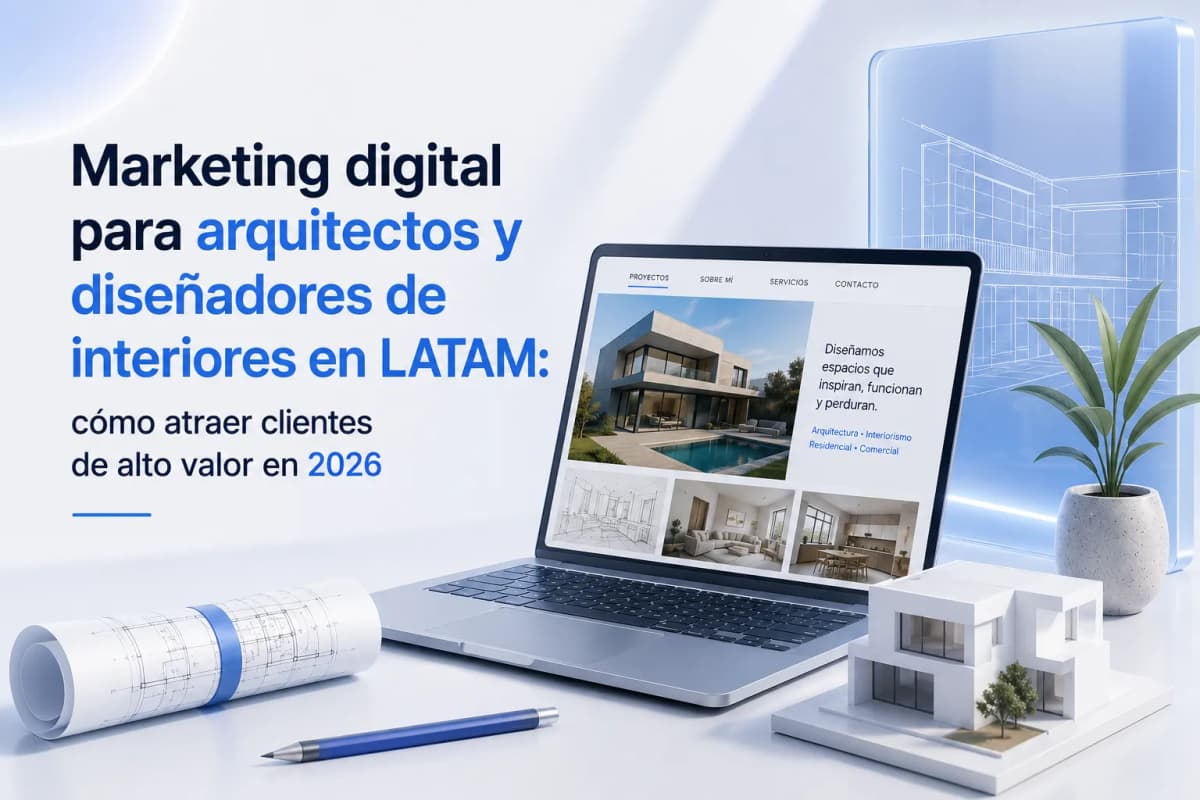
Architects and interior designers depend almost exclusively on word of mouth — and that limits growth to the size of their network. The problem is that the ideal architecture and interior design client actively researches before deciding: they browse Instagram profiles, compare projects on Houzz, and search for "architect in [city]" on Google. If you don't have a presence in those channels, you simply don't exist for that client — even if your work is the best in the market.
The 4 Channels That Convert Best for Architects and Interior Designers
Text-based marketing — blogs, text ads, mass email — converts much less in this niche than in other professional services. The architecture and interior design client makes decisions based on visual evidence. The channels that convert are those that let you show that work at its best.
|
Channel |
Content type |
Recommended frequency |
Conversion profile |
|---|---|---|---|
|
|
Project photos, before/after, process stories |
4–5 posts/week |
Discovery + consideration — the client meets you here |
|
Houzz |
Complete projects with high-quality photos and client reviews |
1–2 projects/month + full profile |
High purchase intent — the user is already looking for a professional |
|
Google Business Profile |
Projects, reviews, news updates |
Update every 2 weeks |
Direct conversion — captures "architect in [city]" searches |
|
YouTube |
Finished project tours and design process videos (8–15 min) |
1 video/month |
Credibility + virality — the most shared format in this niche |
Houzz is the most underrated channel for architects. Unlike Instagram, the user entering Houzz is already in active professional search mode — they're not consuming entertainment. A complete profile with well-photographed projects captures that purchase intent without advertising.
YouTube is the highest long-term organic reach channel. A 10-minute tour of a finished project can keep generating views — and inquiries — two or three years after it's published. It's the most shared format in the architecture and interior design niche because clients forward it to their partners and family to show them "what they want."
How to Build a Digital Portfolio That Converts
The digital portfolio is the most important marketing piece for an architect or interior designer. It can live on a website, on Houzz, on Instagram, or all three — but it has to be built with conversion intent, not just exhibition.
Portfolio elements that convert:
|
Element |
Why it converts |
Common mistake |
|---|---|---|
|
Professional photography |
Photo quality is a proxy for work quality for clients who don't know you yet |
Using phone photos for finished projects |
|
Before / after of the same space |
Highest-engagement format in the niche — activates visual comparison and proof of result |
Showing only the result without the starting point |
|
Full process (renders → rough construction → finishes) |
Educates the client on the value of the process, not just the final result |
Only showing the finished project without context |
|
Video testimonials |
More credible than written reviews and more shareable |
Asking for written testimonials when video is possible |
|
Project data sheet |
Square footage, construction timeline, general budget range — the high-value client wants to know if the project is comparable to theirs |
Not including project specifications |
Before/after is the highest-engagement format on Instagram for this niche. A photo of the space before the intervention (even just the pre-renovation state) followed by the result delivers the most powerful visual proof of the work.
Instagram Profile Checklist for Architects and Interior Designers
Instagram is the primary discovery channel for architecture and interior design clients. A poorly configured profile filters out leads before they ever reach your portfolio.
|
Element |
Optimal state |
|---|---|
|
Profile name |
Real name + "Architect / Interior Designer" (not just the firm name) |
|
Bio (150 characters) |
City + specialty + client outcome: "Residential design in NYC. We transform spaces into homes that work and look like they belong in a magazine." |
|
Link in bio |
Links to portfolio site or Houzz profile with complete projects — not the firm's home page |
|
Profile photo |
Professional headshot (not the logo) — in creative services, the client buys the person |
|
Highlights (covers) |
At least 4: "Projects", "Process", "Clients" (testimonials), "About us" |
|
Feed visual consistency |
Same editing palette across all photos — a chaotic feed generates distrust before the first interaction |
|
Process stories |
Minimum 3–4 stories/week with active process (construction, client meetings, new renders) |
|
Geolocated hashtags |
Mix of local (#NYCArchitecture, #LondonInteriorDesign) + niche (#DesignHomes, #InteriorArchitecture) |
|
DM responded within 24h |
A client who writes and doesn't hear back in 24h contacts the next professional on the list |
Monthly Content Plan for Architects and Interior Designers
Consistency of posting matters more than maximum frequency. Posting 4 times a week for two weeks then disappearing for two weeks is worse than posting 3 times a week consistently.
|
Week |
Format |
Suggested content |
|---|---|---|
|
Week 1 |
Gallery (4–8 photos) |
Finished project: hero image + details + mood shots |
|
Week 1 |
Stories (4–5 frames) |
Week's active process — construction site, materials, client meeting |
|
Week 2 |
Reel (30–60 sec) |
Before / after of the same space with transition |
|
Week 2 |
Story with poll |
Render of ongoing project + "Which palette would you choose?" |
|
Week 3 |
Carousel (6–8 slides) |
Full process: brief → renders → construction → result |
|
Week 3 |
Video story |
Client testimonial — recorded in the finished space |
|
Week 4 |
Detail gallery |
Material, texture, or standout design element from the month |
|
Week 4 |
Story + DM |
"Are you thinking about renovating your space in 2026?" — open direct conversation |
YouTube cadence: one project tour per month is the minimum viable rhythm. The video doesn't need sophisticated production — a phone with good lighting and a narration of the process (what the client asked for, what was designed and why) is enough to build the trust this niche needs.
How to Position Yourself in a Specific Niche
Generic competition in "architect / interior designer" is high in any major city. Positioning in a specific niche means your ideal client finds you instead of the general competition.
Three niches with high demand and high-value clients:
|
Niche |
Why it works |
How to communicate it on Instagram |
|---|---|---|
|
Luxury residences |
High-budget client, values exclusivity, recommends within their social network |
High-quality photography, signature materials, large-scale projects |
|
Sustainable commercial spaces |
Company needing certification or green credential, higher ticket per sq ft |
Process content, sustainable materials, project technical sheets |
|
Apartment renovation |
High volume of clients in cities with active real estate markets |
Before/after of specific units, price per sq ft communicated transparently |
A niche doesn't take clients away — it gives you the right ones. An architect positioned in apartment renovation in a specific city receives inquiries from clients who already understand the type of work and the price range before reaching out.
How to Get the First Clients without an Extensive Portfolio
Without finished projects to show, visual marketing is difficult. But there are two strategies that build a portfolio and generate leads at the same time:
Strategy 1 — Cost-price projects in exchange for photography and testimonial
Offer 1–2 projects at cost price (materials + minimal labor) in exchange for: professional photography paid by the client or shared, permission to use the project in portfolio and social media, and a video testimonial. One well-photographed project is worth more for marketing than the profit margin on that project.
Strategy 2 — Contractor partnerships
General contractors have ongoing clients who need design services. A formal referral arrangement — where the designer receives introductions and the contractor offers a more complete service — provides access to real projects without independent marketing. The condition: document every project photographically from day one.
Ready to Get More Clients?
At Asio, we teach you to implement these strategies step by step through the Mastery program — combining Meta Ads and conversational automation so you get more appointments and close more sales, without relying on manual messages.