Back to Blog
Retain More Clients and Reduce Cancellations in Service Businesses 2026

Most coaches and consultants spend 80% of their time acquiring new clients — when retaining one costs 5 to 7 times less than acquiring a new one. The deeper problem is that 68% of clients who cancel do so because they feel you don't value them, not because the service was bad or they found something cheaper. The solution isn't more marketing — it's a retention structure that operates during the service, not after the client is already gone.
The 3 Real Reasons Clients Cancel in Coaching and Consulting
Most coaches and consultants attribute cancellations to price or competition. Actual client tracking consistently shows the real cause is almost always one of three things:
|
Reason |
How it shows up |
Early signal |
|---|---|---|
|
Misaligned expectations |
The client expected different results than the service can deliver in the agreed timeline |
Frequent questions about "when will I see X" in the first 2 weeks |
|
Lack of proactive follow-up |
The client feels they handed over money and nothing is happening — the provider responds when asked, but never initiates |
Slow message responses, few provider-initiated touchpoints |
|
No visible progress |
The client is 4–6 weeks in and can't describe what changed — final results may take 3 months, but progress needs to be visible week by week |
"I still don't know if this is working" |
The most common design mistake: structuring the service only around final deliverables — the report, the monthly session, the 90-day outcome. Coaching and consulting clients don't cancel at the end of the contract. They cancel between weeks 3 and 8, when they've already paid but have no evidence yet that it's worth it.
The Onboarding Week That Predicts 90-Day Retention
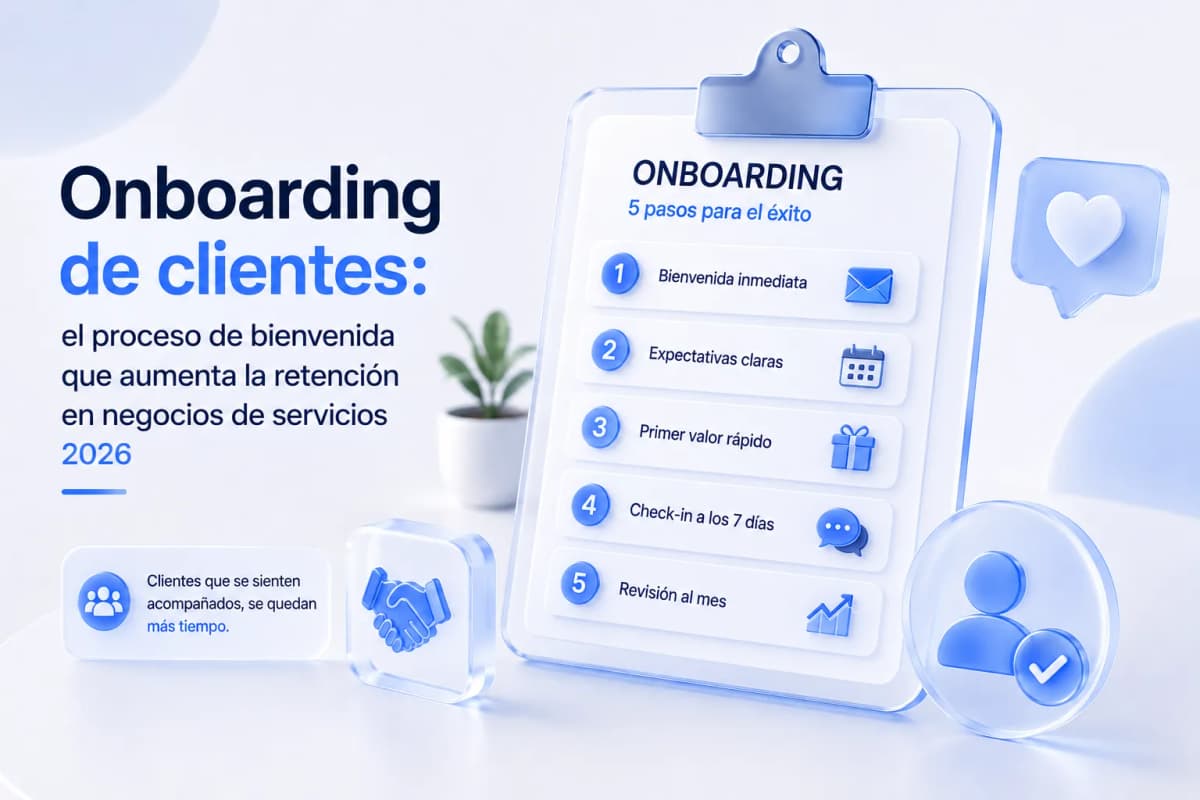
The first week after a client pays is the most important for determining whether they'll still be a client at month 3. A client with an excellent first week completes 70% of the journey toward renewal; a client with a silent first week starts doubting by day 4.
What has to happen in the first 7 days:
|
Action |
Day |
Goal |
|---|---|---|
|
Personalized welcome message (WhatsApp or email) |
Day 1 — within 2 hours of payment |
The client feels something has started, not that they're waiting |
|
Onboarding call or video session (30–45 min) |
Days 2–3 |
Align expectations, understand their real situation, define the first shared milestone |
|
Starter resources or material access |
Days 3–5 |
The client can do something this week — immediate progress |
|
First "how's it going?" check |
Days 6–7 |
The client knows someone is tracking their progress |
The onboarding call is the most important. The goal isn't to explain how the service works — that can be done in writing. The goal is to understand exactly where the client is today, what they specifically expect at month 1 and month 3, and what "this worked" means to them. That information defines the milestones you'll show throughout the service.
The onboarding questions that matter most:
- What do you want to be different in 90 days?
- How will you know this worked?
- Is there anything you've tried before that didn't work?
The 30-Day Check-in: How to Adjust Before the Client Thinks of Leaving
The month 1 check-in is a diagnostic point, not a celebration. The client already has enough experience to know whether the service feels like they expected — and there's still time to make adjustments before dissatisfaction becomes intent to cancel.
The 4 questions for the 30-day check-in:
- "What was the most valuable thing about this first month?" — Tells you what's working and what to reinforce
- "Is there anything you expected that you haven't seen yet?" — Opens the misaligned expectations conversation before the client has to complain
- "On a scale of 1 to 10, how clear is your sense of progress so far?" — A score below 7 signals that intermediate milestones aren't visible enough
- "Is there anything we can adjust to make month 2 more useful?" — Gives the client control over the service, which directly reduces cancellation likelihood
30-day check-in script (WhatsApp):
"[Name], we've been working together for a month now. I wanted to pause and make sure the service is delivering what you expected. Can you answer 2 quick questions? What was the most valuable thing from the month? Is there anything you'd adjust for month 2? Take your time — I genuinely want to know."
How to Show Weekly Progress When Final Results Take Time
This is the most overlooked element in coaching and consulting service design: clients can't wait 3 months without feeling they're moving forward. Final results may take time — but progress can't be invisible.
Intermediate milestones by service type:
|
Service type |
Final result (month 3) |
Visible milestone week 2 |
Visible milestone week 4 |
|---|---|---|---|
|
Business coaching |
+30% revenue increase |
First diagnostic session completed + documented plan |
First action implemented with a measurable result |
|
Marketing consulting |
Active funnel generating leads |
Current state audit completed |
First ad active with initial data |
|
Content agency |
Positioned channel with engaged audience |
First 4 posts published with initial metrics |
Analysis of which content type gets the best response |
|
Individual mentorship |
Business clarity and action plan |
Current situation map completed |
First major decision made with clear reasoning |
How to communicate intermediate milestones: don't wait for the client to notice them. Document and send weekly. A short message — "This week we made progress on X, the next step is Y" — does more for retention than an excellent session the client couldn't interpret.
The Moment of Value: The Specific Result That Decides Renewal
Every service has a "moment of value" — the point where the client experiences a result so concrete that the decision to renew becomes obvious. The problem is that most service providers don't know what that moment is for each client type, or don't work proactively to accelerate it.
Moments of value by client type:
- Sales coach → business owner client: the moment is when the client closes their first sale using the new process. Not when they learn the process — when they use it and it works.
- Marketing consultant → business owner: the moment is when the client sees their first week of inbound leads through the channel you built together.
- Content agency → coach or consultant: the moment is when someone who discovered them through the content reaches out to buy.
How to accelerate the moment of value: identify what that moment is for your service and design the first 4 weeks of the contract so the client experiences it as early as possible. If the moment of value normally arrives at month 3, ask yourself what could happen in week 6 that's a smaller version of that result.
The Proactive Renewal Conversation: 30 Days Before Expiration
The most expensive retention mistake: waiting for the contract to expire to talk about renewal. At that point, the client has already evaluated whether to continue — and if they had a bad week, the decision may already be made.
The renewal conversation needs to happen 30 days before expiration, while the client is still inside the service, still receiving value, and the relationship is active.
Structure of the proactive renewal conversation (3 steps):
Step 1 — Take stock (don't sell yet):
"[Name], in [X] days our program ends. Before we get to the end, I wanted to do a review with you. What's been the most valuable part of these [X] months?"
Step 2 — Connect to the next problem:
"Based on what we've worked on, the natural next challenge for you is [X]. Is that something you want to keep working on?"
Step 3 — Present the continuity option (don't pressure):
"I have [Option A] and [Option B] for continuing. [Option A] is [brief description and price]. Which one makes more sense for you right now?"
Why this works: the client doesn't feel like they're being sold to — they feel like you're planning their continuity alongside them. And if they responded well to the step 1 and 2 questions, the decision was already made before step 3.
The Retention Metrics That Matter
|
Metric |
Formula |
Healthy benchmark |
|---|---|---|
|
Monthly churn rate |
Clients who cancelled ÷ Active clients at start of month |
Less than 5% monthly for coaching/consulting |
|
NPS (Net Promoter Score) |
% promoters (9–10) − % detractors (0–6), on a 0–10 scale |
Above +40 is good; +60 is excellent |
|
LTV (Customer Lifetime Value) |
Average monthly revenue per client × Average months retained |
Minimum 3x the CAC (customer acquisition cost) |
|
Renewal rate |
Clients who renewed ÷ Clients whose contract expired |
Above 60% for 3–6 month contracts |
Monthly churn rate is the most actionable metric: above 5%, you have an active retention problem. Between 3–5% means the service works but there's friction. Below 3% indicates retention is being actively managed.
Simple NPS for service businesses: one question, sent at month 2 and before renewal: "On a scale of 0 to 10, how likely are you to recommend us to someone in your network?" Anyone who responds 6 or below deserves a personalized diagnostic message before the contract ends.
Monthly Retention Checklist
|
Week |
Action |
Channel |
|---|---|---|
|
Week 1 |
Send previous month's progress report with milestones achieved |
WhatsApp or email |
|
Week 1 |
Review monthly churn rate: were there cancellations? What caused them? |
Internal dashboard |
|
Week 2 |
Proactive check-in with clients in their 2nd month (highest cancellation risk) |
|
|
Week 2 |
Send NPS survey to clients completing 2 months |
WhatsApp or email |
|
Week 3 |
Identify clients whose contract expires in 30 days — start renewal conversation |
|
|
Week 3 |
Create or update the week's visible progress milestone for each active client |
WhatsApp or session |
|
Week 4 |
Review average LTV and monthly renewal rate |
Internal dashboard |
|
Week 4 |
Month-end note to all active clients: what we advanced, what's coming |
WhatsApp or email |
Ready to Get More Clients?
At Asio, we teach you to implement these strategies step by step through the Mastery program — combining Meta Ads and conversational automation so you get more appointments and close more sales, without relying on manual messages.