Back to Blog
Local SEO for Service Professionals in the US, Canada, and UK: How to Appear on Google Without Paying for Ads in 2026
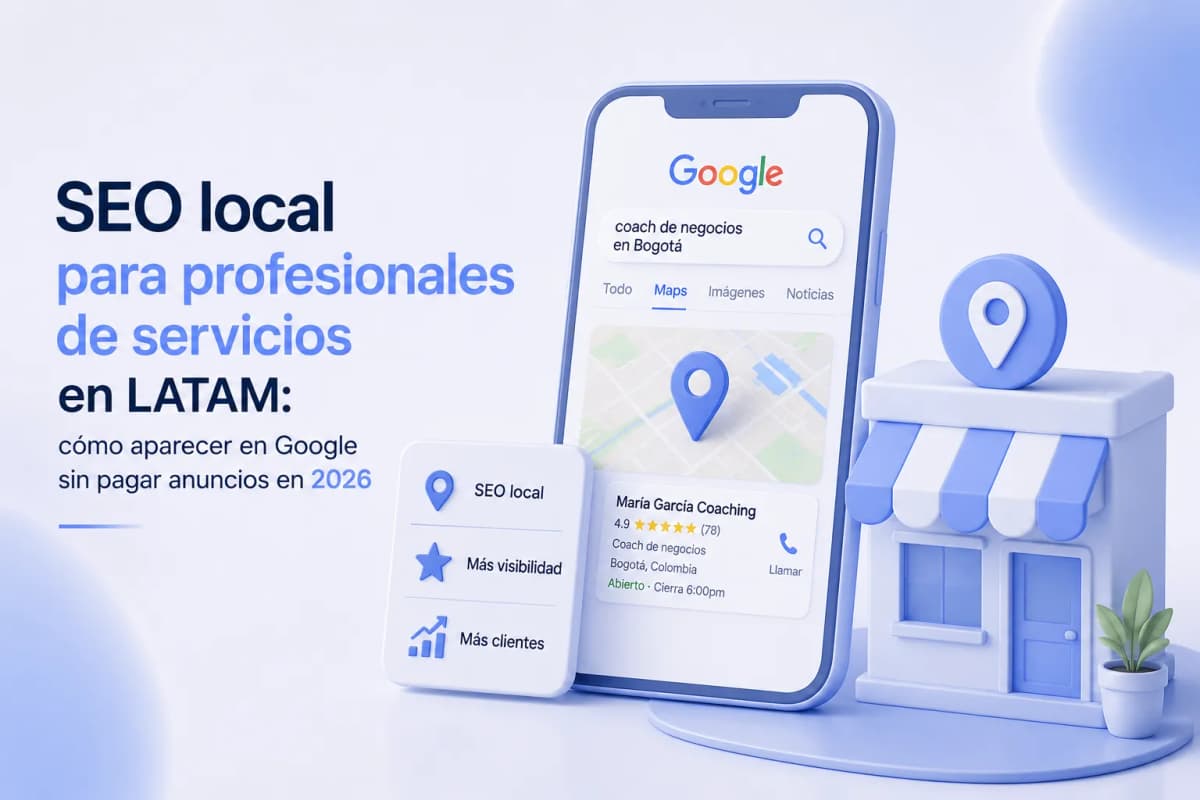
Local SEO is the most underrated acquisition channel for service professionals — it doesn't require a monthly ad budget, and once you rank, traffic doesn't stop when you pause spending. The trade-off is patience: local SEO takes 3–6 months to show consistent results. It isn't a quick fix. It's a permanent asset that keeps delivering while your competitors pay for every click.
What is Local SEO and How is it Different from Regular SEO?
National SEO targets searches without a location signal: "business coach," "family lawyer." You're competing against the entire English-language internet. Local SEO is different: it targets searches with explicit or implicit geographic intent — "dentist in Chicago," "business coach in Toronto," "employment lawyer near me."
The difference isn't just in search volume — it's in intent. Someone who searches "dentist in Chicago" has usually already decided they need a dentist and is looking for who to call. That makes local SEO one of the few traffic sources where the visitor is already in buying mode before landing on your site.
Google displays local results in two formats:
- Map Pack (Local Pack): the three highlighted businesses with a map, star ratings, and phone number that appear above organic results. Controlled primarily by your Google Business Profile.
- Local organic results: web pages that mention the city and service in their content. Controlled by your website's structure and copy.
For a service professional, ranking in the Map Pack for their city is the highest-ROI SEO objective. It's faster than organic ranking and converts better because the phone number and reviews are visible directly in the result.
Google Business Profile: The #1 Local SEO Asset for Service Businesses
If you only have time for one local SEO action, this is it: complete and actively maintain your Google Business Profile (GBP). Google uses it as the primary signal to decide which businesses to show in the Map Pack.
What "complete" actually means:
|
Field |
SEO impact |
Concrete action |
|---|---|---|
|
Primary category |
High — defines which searches you appear for |
Choose the most specific category available: "Cosmetic Dentist," not just "Dentist" |
|
Secondary categories |
Medium |
Add up to 9 additional categories covering your service range |
|
Business description |
Medium |
750 characters; include your city and main service in the first two sentences |
|
Services and prices |
High |
Add each service with a description — Google indexes them as keywords |
|
Hours |
High |
Must be accurate; inconsistent hours penalize ranking |
|
Photos |
Medium-High |
Minimum 10 photos: exterior, interior, team, work results. Update monthly |
|
Weekly posts |
Medium |
One post per week: offer, update, tip. Google weighs recent activity |
The most underestimated signal: the business name. If your business is listed as "Rivera Consulting" but you offer sales coaching in Toronto, consider whether "Rivera Sales Coaching Toronto" better reflects what you do — descriptive names have a natural advantage in local searches.
Tools to complement your GBP:
|
Tool |
Cost |
Use |
|---|---|---|
|
Google Business Profile |
Free |
The main asset: Map Pack, reviews, direct calls |
|
Google Search Console |
Free |
See which searches are already surfacing your site |
|
Google Keyword Planner |
Free (needs an Ads account) |
Validate local search volume before creating content |
Local Keywords: How to Find Them Without Spending Money
The local keyword formula is straightforward: service + city. "Employment lawyer in Toronto," "child psychologist in Vancouver," "business coach in London." What varies is knowing which specific combinations your audience actually searches — and two free tools cover this.
Google Search Console: if your website is verified in Search Console, go to Performance → Queries. You'll see which searches are already triggering your site in Google results. Filter by city to see which local combinations are generating impressions — those are keywords where you're almost ranking, and where optimization effort has the highest immediate return.
Google Keyword Planner: access it with any Google Ads account (you don't need to spend money to use the tool). Under "Discover new keywords," enter your main service. Then filter by location (your city or region). Sort by average monthly searches. Note the 10–15 combinations with more than 100 searches/month — those are your targets.
What to do with the keywords once you have them:
- Include the primary keyword (service + city) in the H1 title of your homepage
- Mention the city in the first paragraph of your homepage text
- Create a separate page per city if you serve more than one (don't merge all cities onto one page)
- Use long-tail variations as blog topics: "how much does a business coach cost in Toronto," "how to choose an employment lawyer in London"
The 3 Most Impactful Local SEO Actions for Service Professionals
1. Complete and Active Google Business Profile
We covered this in detail above, but it's worth reinforcing: most service professionals create their profile, add a name, address, and phone number, and forget it. That's not optimization — that's existing. The difference between a profile that ranks in the Map Pack and one that doesn't is almost always completeness and recent activity (new photos, posts, review responses).
Minimum activity to maintain active signals:
- New photo: every 2–4 weeks
- Post: every week (a short tip or a current offer)
- Response to every review: within 48 hours
2. Google Reviews: How to Request Them Systematically
Reviews are the most visible local ranking factor — and the one that most influences a prospect who already found you on Google. A profile with 4.8 stars and 60 reviews wins almost every time against a profile with 5 stars and 3 reviews.
The most common mistake: waiting for clients to leave reviews on their own. The spontaneous review rate is 2–5%. With an active request system, it can rise to 20–40%.
Basic review request system:
- Create the direct link to your review form: in Google Business Profile → "Get more reviews" → copy the link
- Add that link to a WhatsApp message or email you send 24–48 hours after delivering the service
- The message is simple: "It was a pleasure working with you. If the service was helpful, a Google review helps us reach more people. Here's the link: [direct link]"
- A gentle follow-up after 7 days if there was no response
Don't offer discounts or gifts in exchange for reviews. Google can remove reviews it detects as incentivized and may penalize the profile.
3. Website with City and Service Mentions in Titles and Text
Your website complements your GBP. Google correlates what the GBP says with what the website says — when both mention the same city and the same service, the signal is reinforced.
The four most important places the city should appear:
|
Element |
Example |
|---|---|
|
Page <title> tag |
"Business Coaching in Toronto | María García" |
|
H1 on the homepage |
"Business Coaching for Entrepreneurs in Toronto" |
|
First paragraph of body text |
"We work with entrepreneurs and professionals in Toronto and the Greater Toronto Area" |
|
Meta description |
"Business coach in Toronto. Helps entrepreneurs..." |
If you serve more than one city, create separate pages — one per city — rather than listing all cities on a single page. A page dedicated to "coaching in Toronto" ranks better for Toronto than a page that mentions Toronto, Vancouver, and Calgary together.
The Blog as a Local SEO Tool: 1 Article Per Week That Ranks
A well-targeted blog post does three things for your local SEO:
- Adds indexable content that Google can associate with your service and city
- Captures long-tail searches that your homepage can't cover alone
- Demonstrates topical authority — Google favors sites that publish consistently in their specialty
Specificity is everything. An article about "business coaching" doesn't rank locally. An article about "how much does a business coach cost in Toronto in 2026" can rank in the top 3 within weeks if local competition is low.
Formulas that work for service professionals:
- "How much does [service] cost in [city] in [year]"
- "[Service] for [client profile] in [city]: complete guide"
- "How to choose a [professional] in [city]: 5 questions to ask before you hire"
- "[X] signs you need [service] in [city]"
Frequency and length: one 800–1,200 word article per week is enough. You don't need 3,000-word pieces — you need specific, well-structured articles that exactly answer what someone is searching for when they type the keyword.
The process in 30–45 minutes per week:
- Choose a long-tail keyword from your Google Keyword Planner list (10 min)
- Check the current top 3 Google results for that keyword — note what they cover (5 min)
- Write an article that covers the same points but more thoroughly, with locally specific data (20–30 min)
- Add a CTA at the end linking to your service or contact page
Differences by Market: US, Canada, and UK
Local SEO works on the same principles across all three markets, but the competitive context and user behavior differ:
|
Market |
Particularities |
Practical implication |
|---|---|---|
|
United States |
Highest local SEO competition, especially in major metros (New York, LA, Chicago). Google Business Profile is the dominant local discovery tool |
In large US metros, expect 6–12 months in competitive niches. In medium-sized cities (Raleigh, Tucson, Boise), 2–4 months is realistic with consistent effort |
|
Canada |
Lower competition density than the US in most cities outside Toronto and Vancouver. Google Maps dominates local search |
Cities like Calgary, Edmonton, Ottawa, and Halifax offer faster ranking opportunities — a professional with 30+ reviews and an optimized GBP can rank in the Map Pack in 6–10 weeks in many service categories |
|
United Kingdom |
Bing has higher market share than in North America, making a Bing Places listing worthwhile alongside GBP. Outside London, most medium cities have low local SEO competition |
Outside Greater London, local professionals can rank in the Map Pack with relatively modest effort. Birmingham, Manchester, and Edinburgh are more competitive but accessible with consistent work over 3–4 months |
30-Day Local SEO Checklist
|
Days |
Task |
Concrete action |
|---|---|---|
|
1–3 |
Create or claim your Google Business Profile |
Verify ownership and confirm your primary category is as specific as possible |
|
4–7 |
Complete the GBP to 100% |
Description, services, hours, photos (minimum 10), phone number and website |
|
8–10 |
Set up Google Search Console |
Verify the site, wait for first impressions, note which queries are already generating traffic |
|
11–13 |
Research local keywords |
Use Google Keyword Planner to identify 10–15 service + city keywords with search volume |
|
14–17 |
Optimize your homepage |
Add the city to the H1, first paragraph, and <title> tag |
|
18–20 |
Build a review request system |
Write the message, create the direct review link, test it with 3–5 recent clients |
|
21–24 |
Publish your first blog post |
Choose the long-tail keyword with the most potential and least competition, write 800–1,000 words |
|
25–27 |
First round of GBP posts |
Publish 2–3 posts (offer, tip, team introduction) |
|
28–30 |
Review initial metrics |
In Search Console: new impressions. In GBP: calls, site visits, direction requests |
The first 30 days establish the foundation. Results — increased Map Pack visibility and early organic rankings — appear in months 2–6.
Ready to Get More Clients?
At Asio, we teach you to implement these strategies step by step through the Mastery program — combining local SEO, Meta Ads, and conversational automation so you get more appointments and close more sales, without relying on manual messages.