Back to Blog
Webinar Funnel for Coaches and Consultants: From Stranger to Client in 7 Days
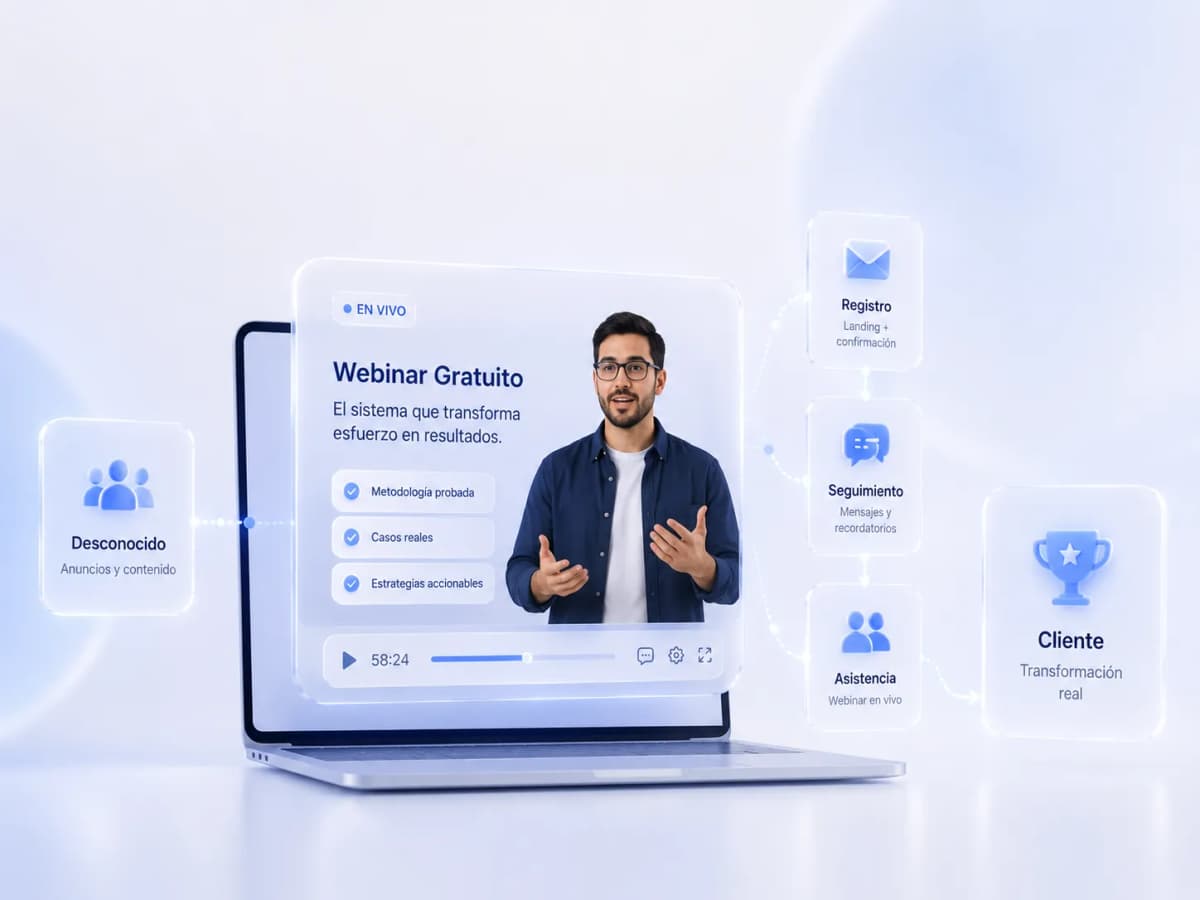
The free webinar is still the highest-converting funnel for medium-to-high ticket services — but only when there's a system behind it. Without a follow-up system, a webinar converts 1–2% of attendees. With one, it converts 8–15%. The difference isn't in the webinar content: it's in what happens before and after. This guide covers the complete funnel, the correct 60–90 minute webinar structure, and the 5 follow-up messages that close sales in the 72 hours after your event.
Why Webinars Still Work for $500–$3,000 USD Services
A sales call requires the prospect to trust you before the conversation starts. A sales page converts cold traffic poorly. A webinar does both jobs in one session: it demonstrates your methodology in real time and pre-qualifies the prospect through the registration commitment.
A coach or consultant selling a $1,500 USD program can't close a cold DM. They need 60 minutes to prove they know what they're doing. The webinar is that space — and when it's structured well, the pitch at the end doesn't feel like a sales moment. It feels like the logical next step after everything the attendee just learned.
The problem: most coaches run webinars without a system. They present, end the session, send one "thanks for attending" email, and wait. That converts 1–2%. The system — the confirmation sequence before and the follow-up sequence after — is what gets you to 8–15%.
The Complete Funnel Diagram
Each link in the chain has a rate that tells you where the funnel is breaking. Low attendance means the confirmation sequence is weak. High attendance but low conversion means the pitch or the follow-up is the problem.
The Confirmation Sequence Before the Webinar
A registrant who receives no messages before the webinar shows up at a 15–25% rate. One who receives three well-written messages shows up at 40–55%.
The minimum sequence:
Message immediately after registering:
"Hey [Name]! You're registered for '[Webinar Title]' on [day] at [time] [timezone]. Your access link: [link]. The webinar runs 90 minutes and I'll take live questions at the end. Save this message so you don't have to search for the link on the day. See you there 🙌"
Reminder 48 hours before:
"Hey [Name], quick reminder that '[Webinar Title]' is [day] at [time]. One question before we get started: what's the biggest obstacle you're facing right now with [the result the webinar promises]? Reply here and I'll make sure to address it in the session."
Reminder 1 hour before:
"🔔 [Name], the webinar starts in 1 hour. Access link: [link]. Join 5 minutes early to confirm your audio and video. See you there."
The 48-hour message with a question serves two purposes: it increases attendance by creating prior commitment, and it gives you real objection language to address during the webinar and the pitch.
The 60–90 Minute Webinar Structure That Sells
The most common and most damaging belief about sales webinars: "spend 75% of the time on value, only 25% on the pitch." That formula produces 60 minutes of generic information followed by 15 minutes of a rushed pitch that nobody buys.
The structure that converts 8–15% isn't that.
|
Block |
Duration |
What it actually does |
|---|---|---|
|
Hook and promise |
10–15 min |
Specific promise, credibility story, why this webinar right now |
|
Re-framing content |
40–50 min |
Doesn't teach tactics — shifts the belief that was blocking the prospect |
|
Pitch |
20–25 min |
Presents the offer as the logical implementation of what they just learned |
|
Live Q&A |
10–15 min |
Eliminates objections that remained after the pitch |
The critical difference is in the "content" block: it's not giving away free tactics the prospect can implement alone. It's identifying the limiting belief that keeps them stuck and dismantling it with your framework. The attendee ends that block thinking "I've never thought of it that way — now I understand why what I've tried before hasn't worked." That's what makes the pitch feel like help rather than a sale.
How to structure the 40–50 minutes of content
- Name the wrong belief your audience holds about why they can't get the result (e.g., "I need a bigger audience before I can sell high-ticket")
- Dismantle it with data, case examples, or your own story
- Introduce your framework as the correct way to think about the problem
- Show the outcome your framework produces — client results, your timeline, measurable proof
- Walk the prospect to the conclusion that they now know the what, but need help with the how
By the time you reach the pitch, the prospect already knows their old belief was the obstacle, understands your framework, and has seen evidence that it works. The pitch question becomes simply: "Do you want help implementing this?"
The Closing Pitch: Presenting the Offer Without the Hard Sell Feel
The transition from content to pitch is where most coaches either stall or rush. Neither works.
The right transition:
"Everything we covered in the last [45] minutes is the framework. You can take this and start implementing on your own — and if you're the type who learns by reading and testing, you'll probably get there in 6–9 months. What I'm going to share now is for those who want to get there in 8–12 weeks with my system and support."
This transition does two things: validates that the content was real (not a teaser), and pre-qualifies the buyer (whoever wants the result faster with less trial and error).
The offer stack — what to include and in what order:
- The core program or service (with the specific outcome)
- Bonuses that eliminate the most common objections ("what if I'm not technical?" → setup bonus; "what if I don't have an audience?" → initial lead generation bonus)
- The guarantee (specific, not generic: "if you don't have your first [result] in 30 days, I refund 100%")
- The price and the price justification (how much does the problem you solve cost them? how much does figuring it out alone cost in time?)
- The close with real urgency (close date, available spots, bonus that expires)
What doesn't work: putting price before benefits, using a vague guarantee, or creating artificial urgency the prospect can see through.
The Post-Webinar Follow-Up Sequence: 5 Messages in 72 Hours
This is the difference between 2% and 12%. Most webinar sales don't close during the webinar — they close in the follow-up. These are the templates:
Message 1 — immediately after the webinar:
"Hey [Name], thanks for being there today. The replay is live for 48 hours here: [link]. The 3 key takeaways from today: [point 1 in one line], [point 2 in one line], [point 3 in one line]. If you have any questions about what we covered, reply here — I read every message."
Message 2 — 6 hours after the webinar:
"Hey [Name], a few people asked me the same thing after the webinar: [the most common question you know comes up]. Short answer: [answer in 2–3 lines]. Full answer is in the replay [link]. And if you want to talk through how it applies to your specific situation, I have 3 spots open this week: [calendar link]."
Message 3 — 24 hours after the webinar:
"Hey [Name], just want to let you know the special offer for [program name] I mentioned in the webinar closes tomorrow at 11:59pm. After that, the price goes up [amount] and the [specific bonus] is no longer included. If you have questions before deciding, I can jump on a call with you in the next 20 minutes. Does now work, or later today?"
Message 4 — 48 hours after the webinar:
"Hey [Name], today is the last day to join [program name] at the webinar price with the bonuses. What's included: [benefit 1], [benefit 2], [benefit 3] — for $[price]. Enrollment closes at 11:59pm tonight. Any questions, I'm right here."
Message 5 — 72 hours / close:
"Hey [Name], enrollment for [program] closed a few hours ago. For those who couldn't make it work right now: I'll open another cohort in [month], but not at this price. I've got your name on the list and will reach out when it opens. And if anything changes in the meantime, you know where to find me. Thanks for trusting me with your time during the webinar 🙏"
Message 5 does something important: it closes without pressure, preserves the relationship, and makes it easy for the prospect to come back later without embarrassment.
Key Metrics: Is Your Funnel Working?
|
Metric |
Healthy target |
What a low rate signals |
|---|---|---|
|
Registration rate (clicks → registrations) |
30–40% |
Weak landing page or poorly targeted traffic |
|
Attendance rate (registered → live attendees) |
40–55% |
Weak confirmation sequence or poor positioning on the registration page |
|
Retention to pitch (attendees who stay through min 60+) |
60–70% |
Content doesn't re-frame; too tactical or too generic |
|
Conversion rate (attendees → clients) |
8–15% |
Rushed pitch, poorly constructed offer, or no follow-up system |
|
Follow-up vs live-close ratio |
50–70% should close in follow-up |
If everyone buys live and nobody in follow-up, the post-webinar system isn't working |
Each metric diagnoses a specific stage. If registration is high but attendance is low, fix the reminders. If attendance is high but conversion is low, fix the pitch or the follow-up sequence.
Tools for Running Webinars
|
Tool |
Price |
Best for |
Key limitation |
|---|---|---|---|
|
Zoom Webinars |
$79–$149 USD/mo |
Maximum interactivity, moderated Q&A, up to 500 attendees |
Attendees must download the app; attendee cap per plan |
|
YouTube Live |
Free |
Unlimited attendees, permanent replay, zero friction to join |
Less control over chat; can't restrict replay after the event |
|
StreamYard |
$25–$49 USD/mo |
Professional visuals, branded lower thirds, screen sharing |
Requires streaming to an external platform (YouTube or Facebook); no native room |
|
Zoom Meetings (not Webinars) |
$15–$20 USD/mo |
Webinars up to 100 with full interactivity |
All attendees have video/audio — less control over the pitch environment |
For coaches just starting out (first 5–10 webinars): Zoom Meetings with waiting room enabled is sufficient and the investment is minimal. For scaling past 200 registrants with polished production: StreamYard broadcasting to YouTube Live, which also provides a permanent replay page.
DM automation integration: connect your webinar registration (Zoom or YouTube) with Instagram DM or WhatsApp via Zapier or Make to automatically deliver the confirmation and reminder sequence without manual intervention. The act of registering triggers the first DM within seconds — that alone increases attendance rates materially.
Ready to Get More Clients?
At Asio, we teach you to implement these strategies step by step through the Mastery program — combining Meta Ads and conversational automation so you get more appointments and close more sales, without relying on manual messages.