Back to Blog
Copywriting for Coaches and Consultants in LATAM: How to Write Texts That Sell Without Sounding Pushy in 2026
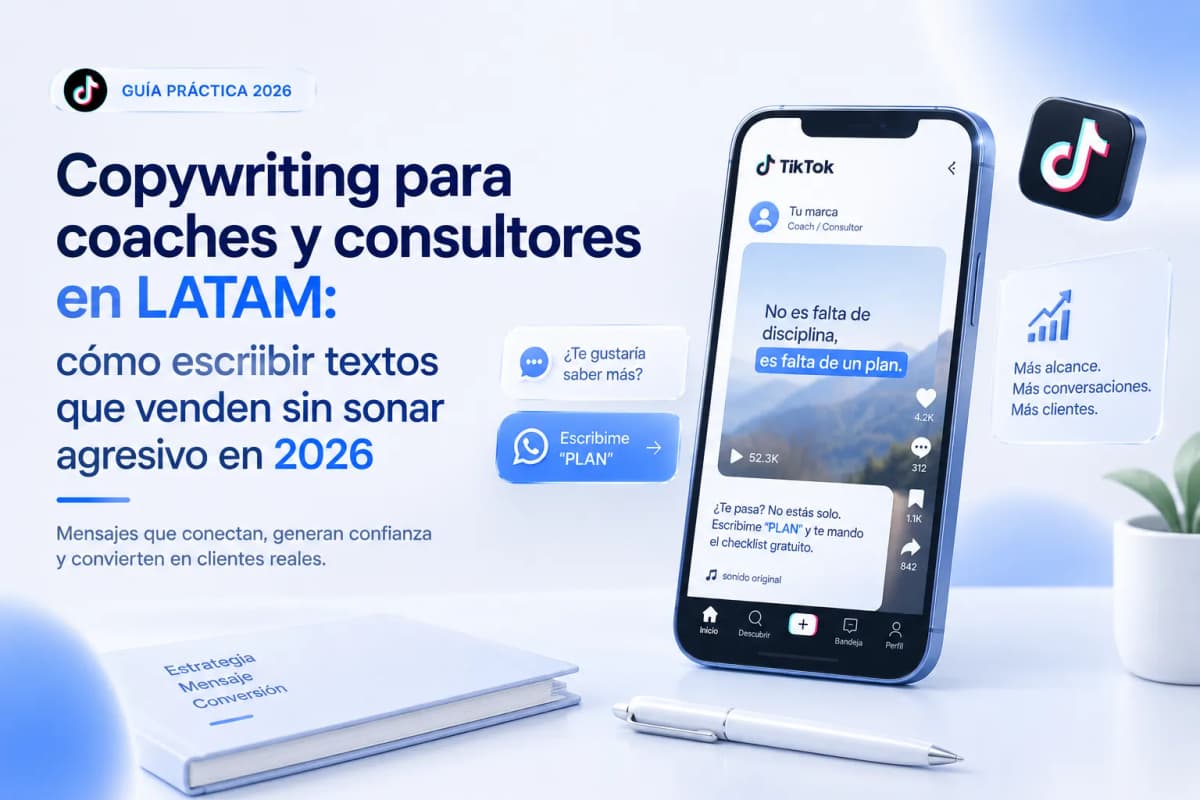
The aggressive copy tactics from the 2010s — "LAST SPOT!", "TODAY ONLY" — no longer work in LATAM: sophisticated buyers scroll right past them. Modern copy that converts is direct, specific, and honest, and the biggest problem isn't that copy is badly written — it's that it talks about the service instead of talking about the client's problem.
Product Copy vs Service Copy: The Mistake That Costs the Most Sales
The most frequent error coaches and consultants make is writing like they're selling a product when they're actually selling a transformation.
|
Product copy |
Service copy |
|---|---|
|
Highlights tangible features: duration, modules, tools |
Highlights intangible results: income, free time, peace of mind |
|
"8-week program with 4 group sessions" |
"Close 3 new clients per month in under 60 days" |
|
The client evaluates whether they have time or money for the course |
The client evaluates whether they want that outcome in their life |
|
Decision is rational: is it worth the price? |
Decision is emotional: can this person actually give me that? |
The rule: the client doesn't buy your methodology — they buy the result of having their problem solved. Every piece of copy must implicitly answer the question "what do I get out of this?" before describing how the service works.
A quick test: cover the price on your offer page and read only the copy. If the text talks about modules, weeks, or tools, the copy is selling the container. If it talks about a problem the reader recognizes as their own and how it gets solved, it's selling the result.
The 5 Copy Formulas That Convert for Coaches and Consultants in LATAM
These formulas work because they organize information in the natural order a prospect uses to make decisions — not because they're manipulation tricks.
|
Formula |
Structure |
When to use it |
|---|---|---|
|
PAS (Problem-Agitation-Solution) |
Name the pain → amplify the consequence → offer the way out |
When the prospect already recognizes they have the problem |
|
BAB (Before-After-Bridge) |
Current situation → desired future → your offer as the bridge |
Webinars, presentations, sales pages |
|
AIDA (Attention-Interest-Desire-Action) |
Hook attention → build interest → create desire → CTA |
Meta Ads, Reel captions, landing page headlines |
|
Pain Point Intro |
Open with the exact phrase the client uses to describe their frustration |
Instagram DMs, WhatsApp messages, first two lines of any copy |
|
Authority Close |
Credential → client transformation → call to action |
Formal proposals, follow-up messages, post-call emails |
PAS on a coaching landing page: step-by-step example
Problem: "Are your discovery sessions filling up with curious prospects who never actually hire you?"
Agitation: "Every call that doesn't close is time and energy you don't get back. Meanwhile your calendar stays half-full and the income you need to scale never arrives."
Solution: "In the Fast Close program you learn to design a sales conversation that converts without pressure — and set up automatic follow-up so the prospects who didn't say yes today come back on their own."
Pain Point Intro: the first message that opens conversations
The most powerful technique for WhatsApp or Instagram DM opening messages is to begin with the exact phrase the prospect uses internally to describe their frustration — not your interpretation of the problem, but their vocabulary.
If your ideal client says "I don't know how to get consistent clients," your first message shouldn't start with "Hi, I'm a business coach." It should start with: "If you've been months without knowing where your next client is coming from..."
How to Write the Bio That Converts on Instagram and WhatsApp
Your Instagram bio has one job: turn the curious visitor into an active prospect before they see a single post. The most common mistake is writing about identity instead of writing about transformation.
The mistake: "I help women transform their lives ✨ | Certified Coach"
The right way: "Business coach for LATAM consultants | Helping you close 3 clients/month without ads | 80+ active clients"
The formula is: who you are (role + credential) → who you serve (specific segment) → concrete result (with a number or timeframe).
|
Element |
Bad example |
Good example |
|---|---|---|
|
Role |
"Coach and entrepreneur" |
"ICF-certified sales coach" |
|
Who you serve |
"I help people grow" |
"For personal development coaches in Mexico" |
|
Result |
"I transform your life" |
"Get 3 new clients per month in 60 days" |
|
CTA |
"Message me" |
"Write 'START' to my WhatsApp → [link]" |
The bio CTA: the link should go directly to a WhatsApp with a pre-filled message or to a capture landing page with no navigation menu. The pre-filled message outperforms a blank chat because it eliminates the friction of knowing what to write — the prospect just taps "Send."
How to Write Meta Ads Copy for $500–$5,000 Services
An ad for high-ticket services on Meta has a different logic from a product ad. It doesn't close inside the ad — it qualifies and opens the conversation.
The structure that works for Click-to-WhatsApp:
Line 1 — hook: touch the pain in the first few words. "Still getting leads who don't buy?" outperforms "Discover my coaching program" every time.
Line 2 — quick credential: one piece of proof that the result is achievable. "I've worked with more than 80 coaches in LATAM who went from 2 to 6 clients per month." No invented statistics — if you don't have the exact number, use a range or a specific story.
Line 3 — low-commitment offer: don't ask them to buy — ask them to talk. "Message me on WhatsApp and I'll send you the free diagnosis" consistently outperforms "Reserve your spot now."
Button CTA: "Send message" for Click-to-WhatsApp, or "Learn more" if the destination is a landing page.
On the creative:
- Short videos (15–45 seconds) of a real niche problem typically outperform static images for service offers
- Subtitles are essential because most content is consumed without sound
- A genuine testimonial video from a real client, without heavy editing, converts better than a polished production with stock footage
The WhatsApp Sales Proposal: Follow-Up That Doesn't Feel Like Harassment
After a discovery call, the prospect needs time to decide. A written WhatsApp proposal has to remind them of the result they want — not pressure them with manufactured urgency.
Post-call message structure:
- Personalized opening: reference something specific from the conversation. "As you mentioned, your main goal is reaching 5 clients per month before December."
- Problem summary: confirm you understood their situation. "Right now the main block is that you don't have a clear process for follow-up after the first call."
- Concrete proposal: service + format + duration + price, no hedging. "I'm proposing the 8-week program with 4 individual sessions and access to the follow-up templates. The investment is USD 1,200, with an option for two payments."
- Low-commitment CTA: "Do you have any questions before deciding?" works better than "When do we start?" because it doesn't pressure — it invites the conversation to continue.
Following up without sounding desperate:
- 24 hours later (if no reply): "Hi [name], just making sure you received the summary. Any questions about the program?"
- 48 hours later (if still no reply): share a relevant resource — a client success story, a short reflection connected to their problem. No mention of the sale.
- 72 hours later: soft close. "I'm closing program spots this week. If you get clarity at any point, happy to pick this back up."
Three touchpoints in three days, without manufactured urgency. What converts isn't pressure — it's relevance at the right moment.
10 Examples: Bad Copy vs Copy That Converts
|
# |
Bad copy |
Copy that converts |
Why it works |
|---|---|---|---|
|
1 |
"Incredible transformational program!" |
"Double your clients in 60 days — method proven with 80 coaches" |
Specific result, credential without empty adjectives |
|
2 |
"Learn my 8-step process" |
"Close 3 new clients per month without chasing prospects" |
Result, not methodology |
|
3 |
"Click here for more info" |
"Write 'INFO' to my WhatsApp and I'll send the free checklist" |
Specific CTA with immediate benefit |
|
4 |
"I'm a great coach" |
"80+ coaches in LATAM use this system — see their results" |
Specific social proof |
|
5 |
"Coaches, this is for you" |
"For personal development coaches in CDMX who want 3 clients/month" |
Precise segmentation |
|
6 |
"Premium high-level service" |
"Client closing program: from 0 to 3 contracts in 8 weeks" |
Eliminates empty adjectives |
|
7 |
"Unique and revolutionary methodology" |
"The system I used to go from 1 to 5 clients without lowering my price" |
Specific, first person, no hyperbole |
|
8 |
"I help women transform their lives" |
"Coaches and consultants: close your first high-ticket client in 30 days" |
Who + result + timeframe |
|
9 |
"Contact me for more information" |
"Want the 3 steps? Reply 'YES' and I'll send them right now" |
Micro-commitment, immediate reply |
|
10 |
"The best program on the market" |
"Three coaches in Colombia closed their first $2,000 client in week 4" |
Concrete result with real context |
Ready to Get More Clients?
At Asio, we teach you to implement these strategies step by step through the Mastery program — combining Meta Ads and conversational automation so you get more appointments and close more sales, without relying on manual messages.