Back to Blog
Digital Marketing for Lawyers and Law Firms: How to Generate Qualified Leads with WhatsApp and Meta in 2026
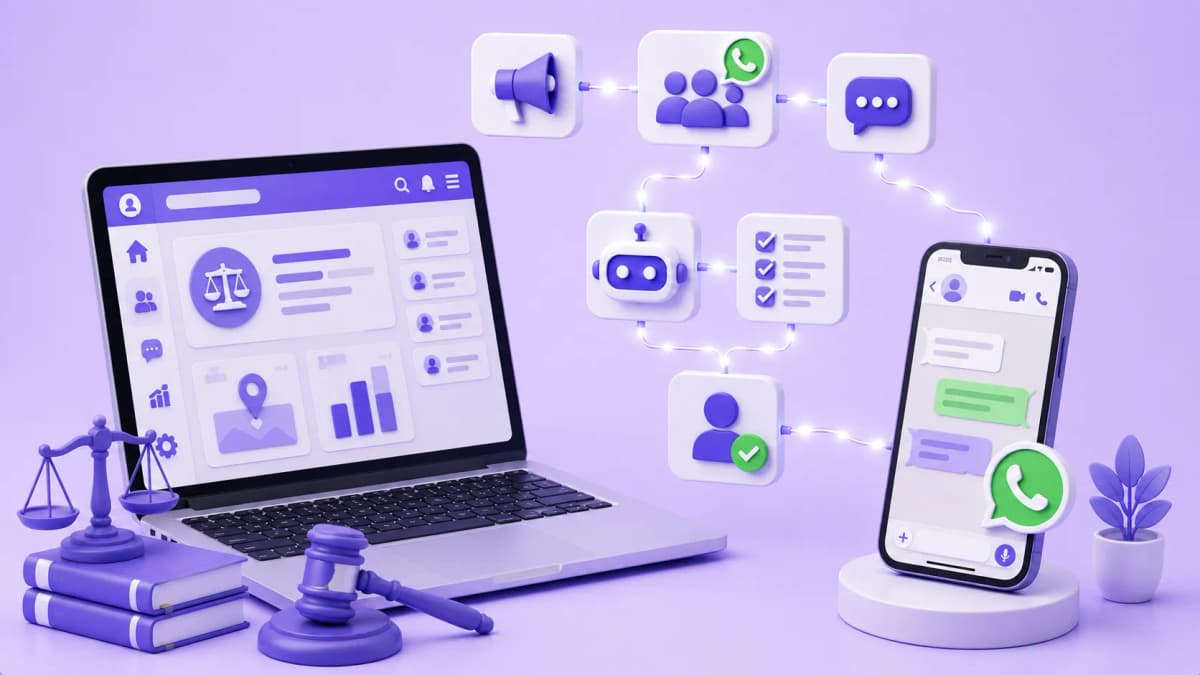
The legal client doesn't call the firm — they Google, read reviews, and then message on WhatsApp or DM. Law firms that understand that journey and automate it generate qualified consultations without depending on referrals or a receptionist managing an inbox.
The Legal Client Journey in 2026
The person who needs a lawyer doesn't open the phone book. The actual journey has three steps:
Step 1 — Search: "divorce attorney near me," "employment lawyer [city]," "family law firm [neighborhood]." The search is always local and always practice-area specific.
Step 2 — Evaluation: the prospect reviews the top 3 Google results, checks the Google Maps rating (reviews), and often visits the firm's website or social profile to see if it looks "current and real."
Step 3 — First contact: instead of calling, they send a message. Calling creates pressure and commitment before the client has decided. Messaging lets them explore without committing — which is why 60–75% of initial inquiries at firms with a visible number come through WhatsApp, SMS, or DM rather than phone.
The problem most firms have: they're visible on Google but have no system that responds to WhatsApp after hours or filters unqualified inquiries before they reach the attorney.
What Lawyers Can and Cannot Say in Digital Ads
Legal advertising is regulated by state bar associations. Violating these rules carries disciplinary risk. The restrictions vary by jurisdiction but follow a common pattern:
What you generally cannot do:
- Promise specific outcomes: "I will win your case" or "100% success rate in family court"
- Use client testimonials that identify the case or the result (attorney-client privilege)
- Make direct comparisons with competing firms
- Use superlatives like "best" or "top-rated" without a verified basis
What you can do:
- Communicate your practice area and focus
- Describe your process without promising an outcome
- Offer an initial consultation as the entry point
- Showcase your team's credentials without linking them to specific case results
This changes the entire structure of the ad: the focus is the client's problem, not the attorney's promise.
Meta Ads for Law Firms: What Works and What Doesn't
Hooks that convert vs. ones that don't
❌ "Top Family Law Firm in [City] — 20 Years of Experience"
✅ "Going through a difficult divorce? Confidential consultation, no commitment required"
❌ "Employment Law Specialists — We Win 90% of Cases"
✅ "Wrongful termination without severance? We'll explain your options in plain language"
❌ "Contact us today to learn more about our services"
✅ "Send us 'CONSULT' and we'll walk you through your situation within 24 hours"
The ad that converts in legal targets the client's problem in the first line — not the firm's history.
Budget and realistic CPL for law firms
|
Market |
Monthly starting budget |
Expected CPL |
Practice areas with best performance |
|---|---|---|---|
|
Major US cities |
$600–$1,500 USD |
$40–$120 USD |
Family law, personal injury, immigration |
|
Mid-size US cities |
$400–$800 USD |
$25–$70 USD |
Employment, family, criminal |
|
Canada |
$400–$800 USD |
$30–$80 USD |
Family, immigration, employment |
|
UK |
$400–$900 USD |
$35–$90 USD |
Family, employment, civil |
Click-to-WhatsApp or Click-to-DM campaigns consistently deliver 25–40% lower CPL than ads that send traffic to a contact form or landing page, because the prospect arrives directly in the conversation without intermediate steps.
The Click-to-WhatsApp Flow for Law Firms
The flow must qualify the prospect before they consume attorney time. A firm without a qualification system ends up with attorneys handling informal inquiries from people who will never retain.
Automated welcome message (ManyChat):
"Hi, thanks for reaching out to [Firm Name]. To point you in the right direction, what area of law can we help you with?A) Family law (divorce, custody, support)
B) Employment law (wrongful termination, severance, contracts)
C) Business law (contracts, incorporation, disputes)
D) Something else"
Branch A — Family law:
Qualification close (all branches):
"Thank you. We have availability for an initial consultation this week. Does Wednesday or Thursday afternoon work for you?"
If the prospect qualifies → tag QUALIFIED_BOOKING + notification to attorney or paralegal with a conversation summary.
If the prospect doesn't respond after the first message → tag NURTURING_21D + 21-day follow-up sequence with educational content about their practice area.
If no response to the sequence → tag COLD_PROSPECT + 30-day pause.
What the bot must NOT do: give legal advice. The bot is a scheduling filter — any question about the specific case gets redirected to "That's exactly what we'll cover in the initial consultation."
Local SEO: How to Rank for "[Attorney Type] in [City]"
Local SEO for law firms has two components that work together:
Google Business Profile:
The Google Maps profile is the first result a mobile user sees when searching for local legal help. Firms that appear in the "local pack" (the 3 results with the map) capture 40–60% of clicks in local legal searches. To optimize it:
- Category set to "Lawyer," "Law Firm," or the most specific practice area Google allows
- Description with the exact terms clients use ("divorce," "custody," "wrongful termination") — not "comprehensive legal services"
- Minimum 10 reviews with text — text reviews carry more algorithmic weight than star ratings alone
- Respond to ALL reviews — the firm's responses appear on the profile and are evaluated by prospects
Practice-area-specific pages on your website:
One page per area ("family law attorney [city]," "employment lawyer [neighborhood]") converts better than a generic services page. The prospect who lands on a page that talks specifically about their problem is significantly more likely to contact than one who lands on a generic homepage.
Ethical Compliance in Legal Digital Marketing
The bar rules vary by jurisdiction, but the general framework for compliant legal advertising in the US, Canada, and UK:
|
Jurisdiction |
Key compliance rule |
What it affects |
|---|---|---|
|
US (most states) |
Cannot promise outcomes; testimonials require disclaimer |
Ad copy, landing pages, social proof |
|
California |
Additional disclaimer requirements for comparative statements |
"Best" / "top" / rankings |
|
Canada (ON, BC) |
Law Society rules limit testimonials and outcome statements |
Ad copy, website |
|
UK (SRA) |
Similar to ABA — no misleading claims about success |
Ad copy, firm descriptions |
The safest approach for compliant ads: describe the client's problem, describe the process, offer the consultation. Never describe the result.
Ready to Get More Clients?
At Asio, we teach you to implement these strategies step by step through the Mastery program — combining Meta Ads, ManyChat, and conversational automation so you get more appointments and close more sales, without relying on manual messages.