Back to Blog
Personal Branding for Coaches and Consultants: Building Online Authority that Attracts Clients Without Chasing Them in 2026
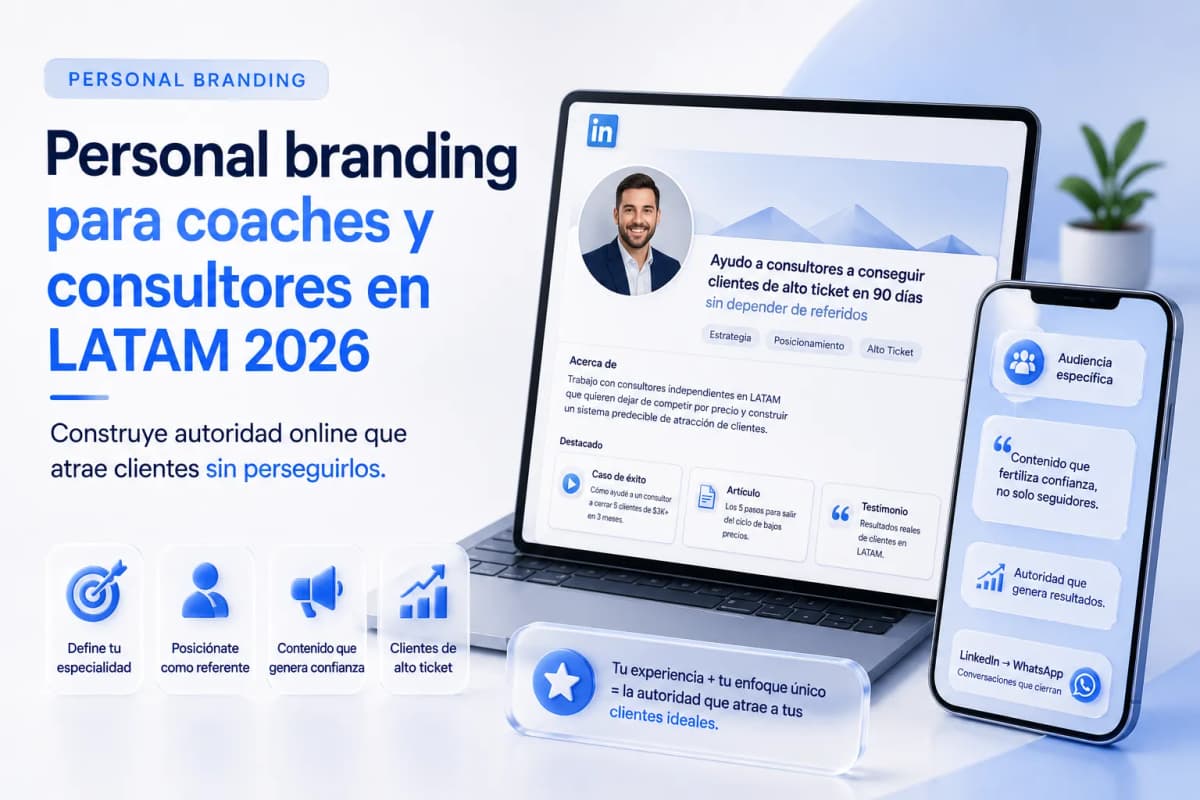
Personal branding isn't about having a large following — it's about being the first person someone thinks of when they have your specific problem. A consultant with 2,000 well-positioned followers can earn more than one with 50,000 generic ones. The most common mistake is the "generic brand": "I'm a life coach," "I help you grow." Without specificity, there's no positioning.
The 4 Pillars of Personal Branding for Coaches and Consultants
Effective personal branding isn't built by publishing more — it's built by answering four questions with precision:
|
Pillar |
Question to answer |
Generic (doesn't work) |
Specific (works) |
|---|---|---|---|
|
Specific problem |
What concrete problem do I solve? |
"I help you grow" |
"I help consultants break out of the low-price cycle" |
|
Specific audience |
Who exactly is this for? |
"Entrepreneurs" |
"Independent consultants in Latin America with 1–3 years of experience" |
|
Unique perspective |
Why is my approach different? |
"With my method" |
"Without changing the offer — by repositioning and repricing" |
|
Consistent format |
In what format do I show up? |
"I post on social media" |
"LinkedIn carousels + a 1,000-word article every two weeks" |
The combination of all four is what turns a digital presence into an asset that works on its own. Missing any one of them, content circulates but doesn't position.
Finding Your Real Differentiator: The 3-Circle Exercise
Most coaches and consultants are clear on what they know how to do. The problem is that what they know isn't automatically what the market is willing to pay for — and even less so if the competition already offers it. The differentiator sits at the intersection:
|
Circle |
Question |
Concrete example |
|---|---|---|
|
What you know how to do |
What skills and experiences do I have that few people combine? |
Coach with 10 years of corporate HR experience in large companies |
|
What the market needs |
What problem is my audience actively trying to solve? |
Burned-out executives who want to perform at a high level without sacrificing their health |
|
What the competition doesn't offer |
What approach or methodology isn't covered by most providers? |
Stress management techniques designed for high-pressure environments — no meditation, no retreats |
The intersection: "Executive coaching for high-performing professionals who want to manage stress without retreats or new-age practices."
That positioning can sit behind an audience of 3,000 followers and generate more revenue than a generic account with 80,000. Specificity doesn't shrink the market — it filters out people who aren't ideal clients and concentrates the attention of those who are.
How to Communicate Your Specialty in One Phrase
Your Instagram bio and LinkedIn headline are the first filter — and the most important one. If someone lands on your profile and doesn't understand in the first 3 seconds what you do and who it's for, they won't keep reading.
The formula that positions:
"I help [specific audience] achieve [specific result] without [main objection]"
Instagram bio examples:
|
Positioning |
Bio that doesn't position |
Bio that does |
|---|---|---|
|
Financial coach |
"Financial coach · Money mindset · Personal finance" |
"I help professionals invest their first $10k without needing to understand the stock market" |
|
Brand consultant |
"Designer and consultant · Branding & strategy" |
"I help coaches and consultants charge more without changing their service — just their positioning" |
|
Executive coach |
"Executive coach · Leadership, wellbeing, productivity" |
"I help executives in LATAM perform at their best without burning out — in 90 days or less" |
On LinkedIn the format shifts slightly:
- Headline (220 characters): not your job title — your value proposition. "Strategy Consultant | 10 years of experience" doesn't position. "I help boutique agencies in Latin America systematize their operations and scale without hiring more" does.
- First 2 lines of About: visible without expanding. They should answer who you help and what result you deliver — the rest can develop the story.
Consistency as an Asset: Why One Topic from Different Angles Wins
The most frequent mistake in content for coaches and consultants is publishing on varied topics: one day finances, the next productivity, the next wellness. The audience doesn't know what to expect or what problem you help them solve.
What builds positioning is publishing about the same thing from different angles:
A financial coach who only publishes about money — but from a different angle each week — builds an authority that no generalist account can replicate:
|
Week |
Format |
Angle of the core topic (money) |
|---|---|---|
|
1 |
Carousel |
The psychology behind not being able to save |
|
2 |
Short video |
The most common investment mistake in your market |
|
3 |
Article |
Why earning more doesn't automatically make you save more |
|
4 |
Post + question |
How much do you think you need to "feel financially secure"? |
Four different formats, four different angles — but all building the same mental association: this professional = money + personal finance.
The practical consequence: when someone in your audience has that problem, they think of you. Not because you posted a lot, but because you posted with thematic consistency.
Building Authority Without a Large Audience
Perceived authority doesn't come from audience size — it comes from the depth of your content and the context in which you appear.
Long-form articles on LinkedIn or Medium (800+ words)
A 1,000-word article on a specific problem in your niche does more for your authority than 30 posts of 100 words. LinkedIn distributes articles to your entire connection network without an algorithmic penalty for long-form. Medium can rank in Google for niche searches. Two articles per month, 12 months of consistency, equals a portfolio of 24 pieces that demonstrates judgment before any sales conversation.
Podcast appearances in your niche
A guest appearance on a podcast with 5,000 listeners in your niche has more positioning impact than weeks of social posts — because the host lends their trust and the listener hears 30–60 minutes of your perspective. You don't need your own audience to appear on podcasts: you need a specific topic, a concrete story or case that adds value to the show's audience, and a short pitch to the host.
Collaborations with complementary professionals
A sales coach and a productivity consultant have different audiences with the same ideal client profile. A joint Instagram Live, a cross-interview, or a co-written article exposes each person to the other's audience without paying for advertising. Well-chosen collaborations are the most underrated growth channel for high-ticket professionals.
The Realistic Timeline for Personal Branding
Personal branding doesn't scale in weeks. Incorrect expectations are the number one reason professionals abandon the process before positioning starts to deliver.
|
Period |
Objective |
Signs it's working |
What to prioritize |
|---|---|---|---|
|
0–6 months |
Niche recognition |
First DMs from strangers asking about your services, mentions from acquaintances, engagement from your target audience |
Define the 4 pillars, publish 3x/week, write 2 articles/month, optimize bio and headline |
|
6–12 months |
Perceived authority |
Invitations to collaborate or appear on podcasts, inquiries from strangers, referrals from existing clients |
Accept strategic collaborations, build LinkedIn, start appearing as a guest on podcasts |
|
12–24 months |
Reference in the topic |
People mention you in conversations you weren't part of, organic third-party sharing, waitlist |
Raise prices, be selective with collaborations, deepen the format that converts best |
The determining factor isn't speed — it's thematic consistency. A professional who publishes on the same specific topic for 18 months without deviating is, statistically, the one who ends up being recognized as a reference in that niche.
Ready to Get More Clients?
At Asio, we teach you to implement these strategies step by step through the Mastery program — combining Meta Ads and conversational automation so you get more appointments and close more sales, without relying on manual messages.