Back to Blog
How to Sell Online Courses Without Followers: Complete Funnel for Info Product Creators in 2026
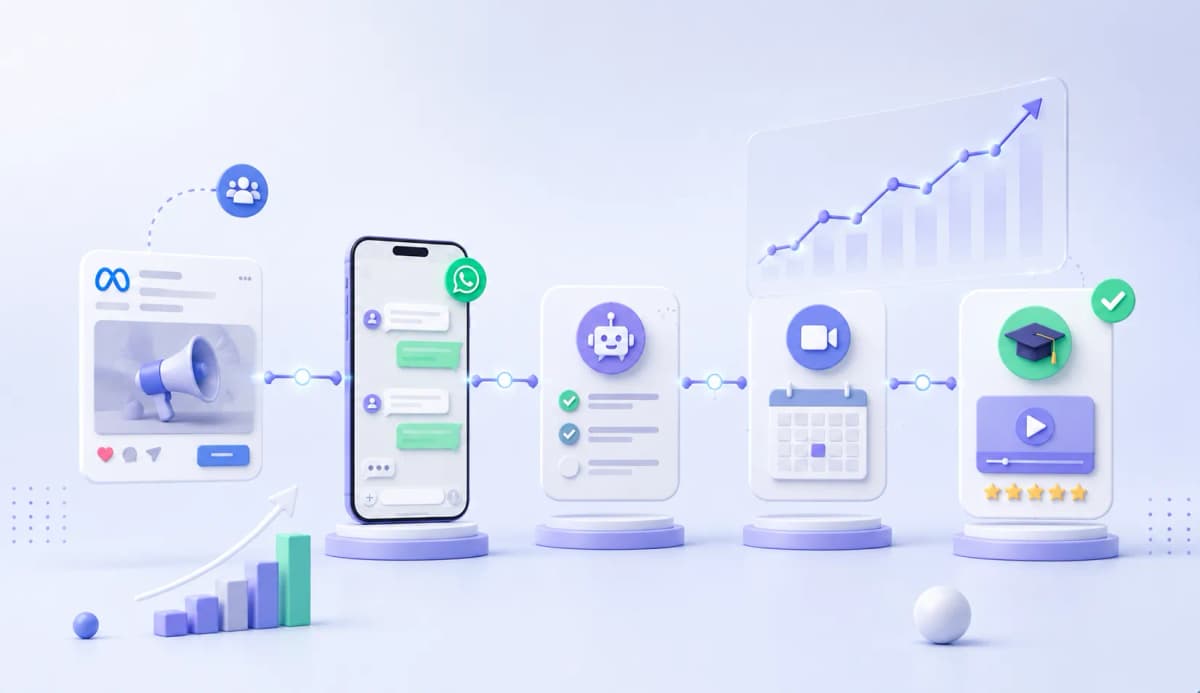
"You need an audience before you can sell" is the most expensive myth in the info product world — it causes thousands of people to spend months building organic reach before attempting a single sale, when in 2026 there's a more direct path: Meta Ads to a qualification bot, discovery session, close. No followers doesn't mean no investment — that's the false premise that needs to be addressed upfront.
The Complete Funnel Without Organic Traffic: 4 Stages
The funnel for selling courses without an existing audience has four sequential stages. None can be skipped — each one filters and prepares the next:
|
Stage |
Tool |
Goal |
Expected output |
|---|---|---|---|
|
1. Attraction |
Meta Ads Click-to-WhatsApp |
Generate conversations with qualified prospects |
CPL of $3–$20 depending on niche |
|
2. Qualification |
ManyChat bot on WhatsApp |
Filter curious browsers from real buyers |
20–35% of leads reach stage 3 |
|
3. Discovery session |
30-minute call or video |
Confirm fit and present the program |
30–50% close rate for well-qualified prospects |
|
4. Close and follow-up |
WhatsApp + Calendly |
Convert, collect payment, confirm access |
No-show rate under 20% with automated reminders |
This sequence works with a $300–$500 USD initial ad investment. With that budget it's possible to generate 20–80 bot conversations (depending on niche and offer), pass 5–15 to a discovery session, and close 2–5 first sales. The goal in the first 30 days isn't to scale — it's to validate that the funnel converts before increasing the budget.
How to Validate Your Course Topic Before Recording It
The mistake most info product creators make: they record the complete course (30–60 hours of work) and then try to sell it. The correct sequence is the reverse.
Step 1 — Launch the ad before creating the content:
Create an ad that describes the course outcome ("learn to close appointments with Meta Ads without a following in 30 days") and bring interested people into a WhatsApp conversation. You don't need the course recorded to know if there's demand — you need to know if people will pay for that outcome.
Step 2 — Run 5 discovery sessions (paid or free):
Talk with the 5–10 most qualified people who came through the ad. Listen to the language they use to describe their problem, what they've already tried, and what price they expect. Those 5 conversations give you more market intelligence than any survey.
Step 3 — Sell before recording (pre-sale):
If 2 of those 5 people are willing to pay now for a program you'll deliver over 4 weeks, you have validation. Charge 50% upfront and deliver live — recorded sessions or live calls. Record the definitive content with real feedback from the first buyers.
Validation costs nothing more than the ad budget — and it eliminates the risk of producing a course nobody wants to buy.
Minimum Budget and What to Expect in the First 30 Days
$300–$500 USD is the recommended test budget. Distributed as:
- $200–$300 on Meta Ads: start with a single ad, a single audience, a single message. Variation at this stage confuses optimization. Campaign objective: Messages (Click-to-WhatsApp), not Conversions.
- $50–$100 on tools: ManyChat Pro ($45/month) + domain or basic landing page if needed.
- $0 on course production: until you've validated.
What to expect in the first 7 days:
Meta's algorithm takes 3–5 days to exit the learning phase. Don't make decisions to pause or change the ad before 48–72 hours of data. A CPL of $8–$20 in the first week is normal; it drops to $3–$10 once the pixel learns and the algorithm optimizes.
What to measure:
- CPL (cost per conversation): total spend divided by conversations started in the bot
- Qualification rate: prospects who complete the full bot / conversations started
- Scheduling rate: prospects who book a session / qualified prospects
- Close rate: sales / sessions completed
If CPL is acceptable but the qualification rate is low (under 15%), the problem is the bot. If the scheduling rate is low, the problem is the post-qualification message. If the close rate is low, the problem is the discovery session.
The Qualification Bot: How to Filter Browsers from Real Buyers
An effective qualification bot for selling courses does three things: confirms there's a real problem, verifies willingness to invest, and eliminates people who only want free content. The flow has 4 questions:
Question 1 — Problem context:
"To give you useful information, which best describes your situation right now?"
A) I have a topic I want to teach but don't know how to start selling it
B) I already have a course but I'm not generating consistent sales
C) I'm evaluating whether creating a course is the right move for me
Option C activates a nurturing flow (free content + 7-day follow-up). Options A and B continue to qualification.
Question 2 — Time horizon:
"When are you looking to have your first sales running?"
A) In the next 30 days
B) In the next 2–3 months
C) I'm still thinking about it
Option C receives the same nurturing flow. Options A and B continue.
Question 3 — Investment:
"Implementing this correctly requires investment in both the training program and the ads. Do you have budget available for this right now?"
A) Yes, I have a defined budget for this
B) I'm evaluating the ROI before deciding
C) Not at this point
Option A leads to direct scheduling. Option B receives a message explaining the model's ROI and asks if they'd like to talk with the team. Option C receives a free resource and the tag BUDGET_PENDING for a 21-day follow-up sequence.
Question 4 — For those who made it this far:
"What's your area of expertise or the topic you want to teach?"
With this answer, the team arrives at the discovery session with real context rather than a blank slate.
ManyChat tags: QUALIFIED_BOOKING for prospects who complete the full flow, NURTURING_21D for those who weren't ready, BUDGET_PENDING for those who blocked on the investment question.
The 30-Minute Close Call
The discovery session has a dual job: confirm that the program is the right fit for this prospect, and close the sale if it is. A poorly structured 45-minute call kills more closes than it generates; well-structured 30 minutes closes more with less friction.
Structure of the 30 minutes:
- 0–5 min — Prospect context: let them describe their situation in their own words. Don't interrupt. Listen to what they mention first (the problem, the outcome they want, or the fear that it won't work) — that signals how the close needs to be framed.
- 5–15 min — Diagnosis: 3–4 questions to understand what they've already tried, why it didn't work, and what resolving this would mean for their business or income.
- 15–22 min — Program presentation: connect each module or component of the course explicitly to something the prospect said in the first 15 minutes. This isn't a feature list — it's "this solves what you told me you can't do right now."
- 22–27 min — Price and options: present the price with confidence, without excessive justification. Offer at most two options (full payment / payment plan). Don't volunteer a discount.
- 27–30 min — Objection handling and close: the three most common objections in info product sales:
"Let me think about it" → "That makes sense. What information do you still need to make the decision? If it's timing, we can hold your spot and confirm in 24 hours."
"What if it doesn't work for me?" → "That's exactly the right question. The program works when [specific condition]. If you meet that and in X weeks you don't have [promised result], let's talk about how to fix that — [guarantee or extended support policy]."
"It's too expensive" → "I understand. Does the outcome you described — [repeat what they said] — have a monetary value for your business? If so, the investment is [price] against [the value they described]. What part of that outcome are you not convinced we can produce?"
Ready to Get More Clients?
At Asio, we teach you to implement these strategies step by step through the Mastery program — combining Meta Ads, ManyChat, and conversational automation so you get more appointments and close more sales, without relying on manual messages.