Back to Blog
Best Hooks for Instagram, TikTok, and Reels to Stop the Scroll in 2026
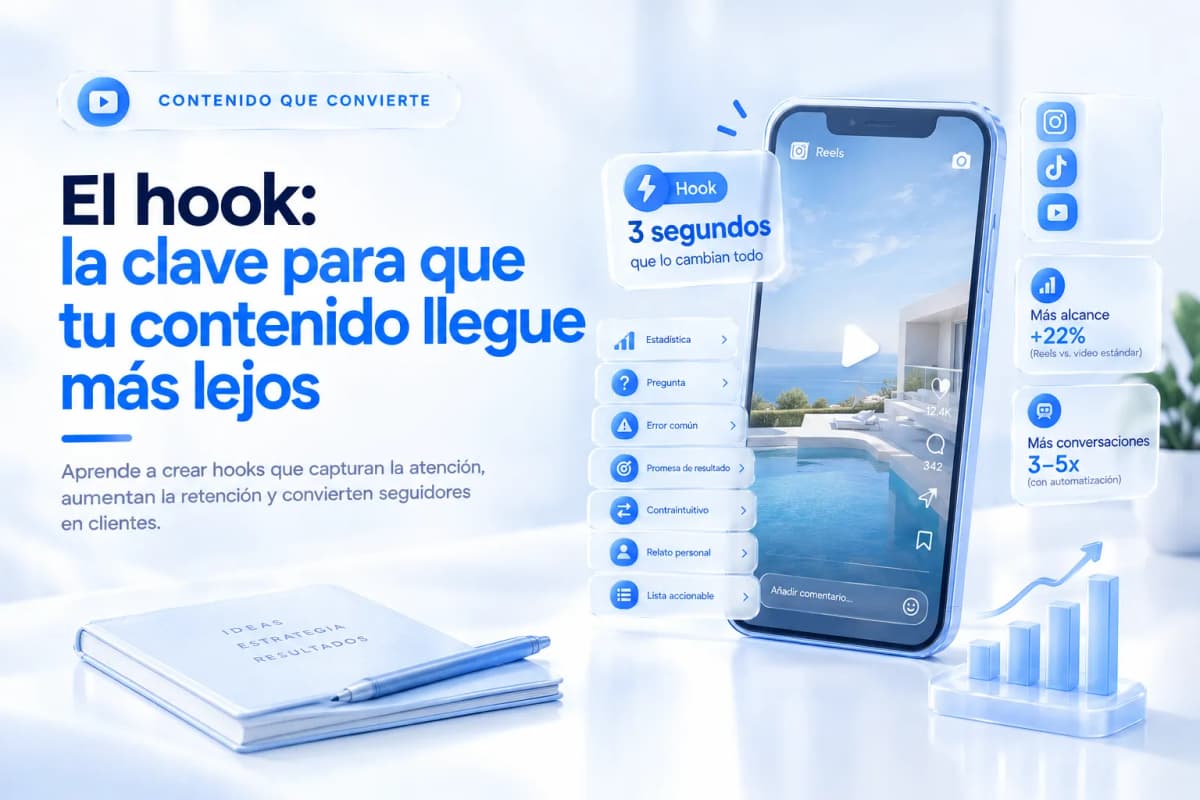
The hook — the first 3 seconds of a Reel or the first 2 lines of a post — isn't a formatting detail. It's the variable that determines whether the algorithm shows your content to a thousand people or ten. Most coaches and consultants write the hook last, after creating the content. That's exactly backwards: the hook comes first, because the content exists to deliver on what the hook promises.
Why the Hook Matters More Than the Content Itself
The Instagram, TikTok, and Reels algorithm doesn't reward good content. It rewards retention. The logic is direct: if people stay to watch or read, the platform interprets the content as relevant and shows it to more people. If people leave in the first 3 seconds (video) or before tapping "more" (text), the algorithm interprets the content as uninteresting — and stops distributing it.
The hook is the door. If nobody walks in, the content doesn't exist.
What happens in the critical window:
|
Format |
Critical window |
What the algorithm measures |
|---|---|---|
|
Reel / TikTok |
First 3 seconds |
Video retention (% that watches past 3 sec / reaches the end) |
|
Text post or carousel |
First 2 lines (before "more") |
Expansion rate + time on screen |
|
Story |
First frame |
Taps forward vs. dwell time |
The practical consequence: you can have the best content in your niche and nobody will see it if the hook doesn't work. And you can have ordinary content with an exceptional hook that reaches 50,000 people. The hook is the distribution; the content is the deep retention.
The 7 Hook Types That Convert Best for Service Professionals
1. The Surprising Statistic
Why it works: activates cognitive dissonance. The reader already had an idea of how the landscape looks — and the hook contradicts it. The need to understand why creates immediate retention.
How to use it well: the statistic has to be about the audience, not the market. "Digital ad spend exceeded $X billion" doesn't stop a coach's scroll. "73% of coaches earn less than $2k/month" does — because the audience is the coach and the statistic speaks directly to them.
Examples:
- "73% of coaches earn less than $2k/month — and the problem isn't what they think"
- "90% of coaches who start don't make it to year 2 in business"
- "The average coach takes 8 months to land their first $1,000 client"
- "Only 12% of independent consultants consistently earn above $5k/month"
- "70% of coaching clients cancel before month 3 — not because of the service"
2. The Uncomfortable Question
Why it works: a question forces an internal answer. If that answer is uncomfortable or unknown, curiosity keeps them engaged. If the internal answer is "yes, that's me," they keep reading to see if there's a solution.
Examples:
- "How long have you been saying you're going to raise your prices?"
- "If your business disappeared tomorrow, how many clients would miss you?"
- "Do you know exactly how much you made last month, or do you have to check?"
- "How many leads came in this week that you didn't follow up on?"
- "When was the last time a client came to you without you actively going after them?"
3. The Mistake Everyone Makes
Why it works: nobody wants to be making a mistake without knowing it. The brain activates high attention at the possibility of unknowingly losing something or doing something wrong.
Examples:
- "The mistake that's keeping your posts from selling"
- "Why your Instagram bio is pushing clients away instead of attracting them"
- "The mistake 80% of coaches make with their first ad"
- "Why your Stories get 300 views but zero messages"
- "What most consultants say in the first DM that loses the sale"
4. The Result Promise
Why it works: the brain evaluates in milliseconds whether attention is worth it. A specific, credible result promise passes that filter because it connects with a real goal the audience has.
The most common mistake: making the promise vague or inflated. "How I made $100k in a month" isn't credible to most audiences. "How I got 3 new clients in 7 days" is — the number is achievable and the timeframe is concrete.
Examples:
- "How I got 3 new clients in 7 days without a single ad"
- "How I went from 2 to 8 clients in 30 days by changing one thing"
- "How I closed my first $2,000 client without a website or funnel"
- "How I filled my calendar in 3 weeks with this method"
- "The system that gives me 5–8 leads per week without posting every day"
5. The Counterintuitive
Why it works: the brain has to resolve the tension between what it knows (or thinks it knows) and what it just read. That tension creates deep attention.
Examples:
- "Why posting more doesn't get you more clients"
- "Why lowering your prices is the worst marketing decision you can make"
- "Why having more followers might be blocking your growth"
- "Why responding too fast in DMs can push high-ticket clients away"
- "Why the best coaches charge for fewer sessions, not more"
6. The Personal Story
Why it works: first-person narrative activates automatic empathy. If the situation feels familiar, retention is very high because the reader wants to know how it ends.
Examples:
- "I was about to lower my prices when I discovered something"
- "The month I stopped selling cheap was the month I earned the most"
- "A year ago I had zero clients. Here's what changed"
- "It took me 2 years to realize the problem wasn't my service — it was my offer"
- "The client I turned down taught me how to sell for real"
7. The Actionable List
Why it works: numbered lists reduce cognitive friction. The brain knows from the start how much time it's investing and what it will get. The specificity of a number ("5 things" vs "some things") increases credibility.
Examples:
- "5 things your competition does that you don't"
- "3 questions that close a sale without the client feeling sold to"
- "7 signs your business is ready to raise prices (checklist)"
- "4 changes I made to my bio that doubled my consultations"
- "The 3 things I do every Monday before posting anything"
35 Ready-to-Use Hooks — Organized by Type
|
# |
Type |
Ready-to-use hook |
|---|---|---|
|
1 |
Statistic |
"73% of coaches earn less than $2k/month — and the problem isn't what they think" |
|
2 |
Statistic |
"90% of coaches who start don't make it to year 2 in business" |
|
3 |
Statistic |
"The average coach takes 8 months to land their first $1,000 client" |
|
4 |
Statistic |
"Only 12% of independent consultants consistently earn above $5k/month" |
|
5 |
Statistic |
"70% of coaching clients cancel before month 3 — not because of the service" |
|
6 |
Uncomfortable question |
"How long have you been saying you're going to raise your prices?" |
|
7 |
Uncomfortable question |
"If your business disappeared tomorrow, how many clients would miss you?" |
|
8 |
Uncomfortable question |
"Do you know exactly how much you made last month, or do you have to check?" |
|
9 |
Uncomfortable question |
"How many leads came in this week that you didn't follow up on?" |
|
10 |
Uncomfortable question |
"When was the last time a client came to you without you actively going after them?" |
|
11 |
Common mistake |
"The mistake that's keeping your posts from selling" |
|
12 |
Common mistake |
"Why your Instagram bio is pushing clients away instead of attracting them" |
|
13 |
Common mistake |
"The mistake 80% of coaches make with their first ad" |
|
14 |
Common mistake |
"Why your Stories get 300 views but zero messages" |
|
15 |
Common mistake |
"What most consultants say in the first DM that loses the sale" |
|
16 |
Result promise |
"How I got 3 new clients in 7 days without a single ad" |
|
17 |
Result promise |
"How I went from 2 to 8 clients in 30 days by changing one thing" |
|
18 |
Result promise |
"How I closed my first $2,000 client without a website or funnel" |
|
19 |
Result promise |
"How I filled my calendar in 3 weeks with this method" |
|
20 |
Result promise |
"The system that gives me 5–8 leads per week without posting every day" |
|
21 |
Counterintuitive |
"Why posting more doesn't get you more clients" |
|
22 |
Counterintuitive |
"Why lowering your prices is the worst marketing decision you can make" |
|
23 |
Counterintuitive |
"Why having more followers might be blocking your growth" |
|
24 |
Counterintuitive |
"Why responding too fast in DMs can push high-ticket clients away" |
|
25 |
Counterintuitive |
"Why the best coaches charge for fewer sessions, not more" |
|
26 |
Personal story |
"I was about to lower my prices when I discovered something" |
|
27 |
Personal story |
"The month I stopped selling cheap was the month I earned the most" |
|
28 |
Personal story |
"A year ago I had zero clients. Here's what changed" |
|
29 |
Personal story |
"It took me 2 years to realize the problem wasn't my service — it was my offer" |
|
30 |
Personal story |
"The client I turned down taught me how to sell for real" |
|
31 |
Actionable list |
"5 things your competition does that you don't" |
|
32 |
Actionable list |
"3 questions that close a sale without the client feeling sold to" |
|
33 |
Actionable list |
"7 signs your business is ready to raise prices (checklist)" |
|
34 |
Actionable list |
"4 changes I made to my bio that doubled my consultations" |
|
35 |
Actionable list |
"The 3 things I do every Monday before posting anything" |
How to Adapt the Hook to Each Format
The same hook concept is implemented differently depending on the format:
Reel and TikTok (short video):
The hook has to work on two layers simultaneously: what's seen and what's heard. The first 3 seconds need to retain visually (a gesture, an object, an angle change) while the first spoken line plants the question or promise. Overlaid text in the first frames helps capture viewers watching without sound.
Structure: impactful first frame + overlaid text that summarizes the hook + first spoken line that expands it in 5–7 words
Text post and carousel (feed):
The hook is roughly the first 125 characters — what appears before "more" on Instagram or before truncation on Facebook. The first 2 lines have to work independently: if the reader doesn't tap "more," the intrigue or emotion already has to be planted.
Structure: line 1 = the hook (statistic, question, promise), line 2 = the tension or context that creates the need to know more
Stories:
The first frame is the hook. Stories scroll in one gesture — if the first frame doesn't capture attention in 1 second, the next Story is already loading. The text on the first frame has to be the complete promise, without needing the next frame to be understood.
Structure: simple background + text that works alone, without additional context
How to Test Hooks Systematically
The only way to know which hook type works best for your specific audience is to publish variants and measure. The market is always right about which hook retains best.
The hook testing method:
- Choose a piece of content whose value you already know (solid advice, a framework you use with clients)
- Write 3 different hooks for that same content — one per type (e.g., statistic, uncomfortable question, counterintuitive)
- Publish on consecutive days — wait 24–48 hours between Reels on the same topic
- Measure within the first 24–48 hours: on video, the key metric is retention rate and % that reaches the end; on text, it's the "more" expansion rate and saves
- The hook with the highest retention in the first 48 hours is the one the algorithm amplified most — that hook type wins for your audience
What NOT to measure: likes. Likes measure those who made it to the end. If 10 people watch the Reel and 8 like it, you know nothing about the 990 who didn't see it because the hook didn't capture them.
Ready to Get More Clients?
At Asio, we teach you to implement these strategies step by step through the Mastery program — combining Meta Ads and conversational automation so you get more appointments and close more sales, without relying on manual messages.