Back to Blog
How to Sell Your Services to Clients in the US or Spain from LATAM: A Practical 2026 Guide
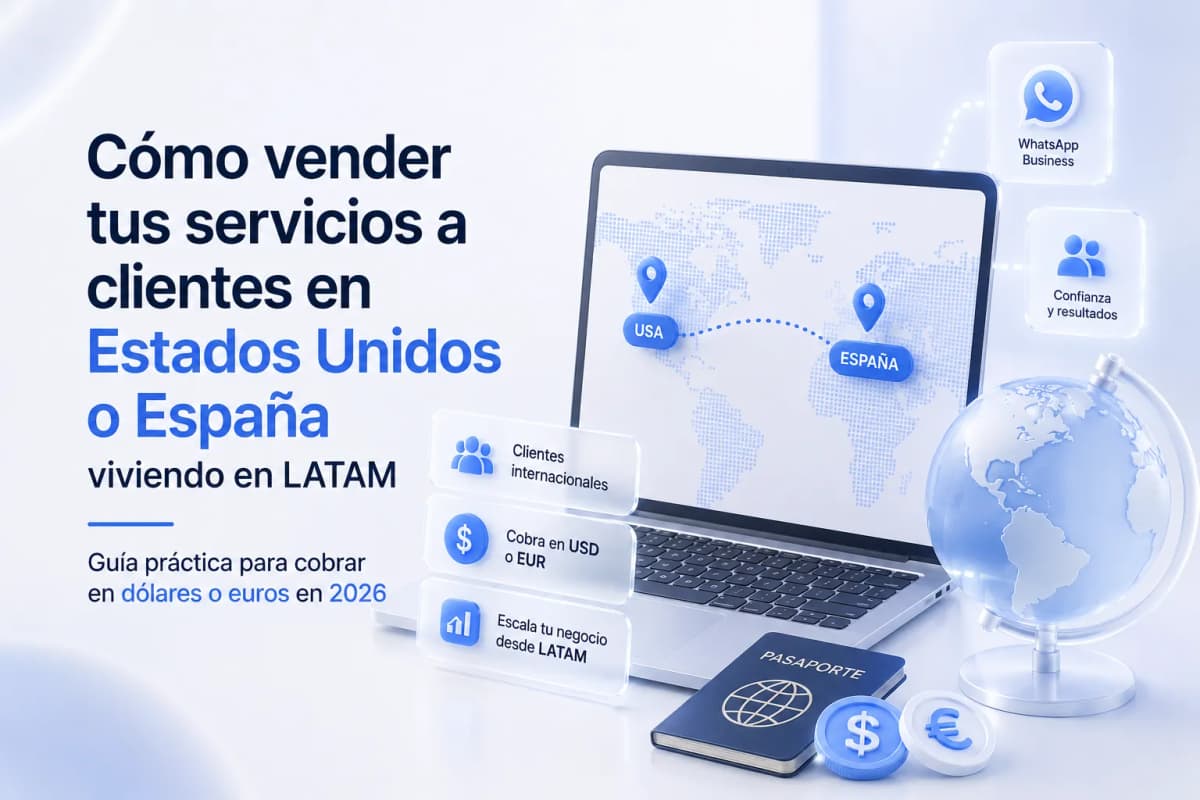
A consultant in LATAM charging in dollars or euros can multiply their income 3–5x without changing what they do — just changing who they do it for. The biggest obstacle isn't language or time zones: it's failing to adapt the positioning for the destination market. What works for coaches in Mexico doesn't automatically work in Miami or Madrid.
Why the Hispanic Market in the US Is the Most Accessible Opportunity from LATAM
There are approximately 55 million Hispanics in the United States, around 25 million of whom are economically active — and a growing share are business owners or hold purchasing authority in their companies. This segment actively seeks services in Spanish, not because they can't speak English, but because they trust providers who understand their cultural context and business environment.
This creates a concrete advantage for the Latin American consultant: you're not competing against consulting firms in Chicago or Madrid — you're competing in a segment where your cultural background is a genuine differentiator, not a disadvantage.
Three most accessible Hispanic client profiles in the US:
|
Profile |
What they're looking for |
Most in-demand services |
|---|---|---|
|
First-generation Latino entrepreneur |
Growing their US business without losing their origin market |
Business coaching, digital marketing in Spanish |
|
Mid-size company with Hispanic market |
Communicating better with their Hispanic audience |
Content strategy, social media management, Spanish-language ads |
|
Professional immigrant with independent business |
Formalizing, growing, and understanding the US tax system |
Tax consulting, business mentoring |
How to Position Yourself for a US or Spanish Client
The positioning that works in Latin America — local client testimonials, local-currency pricing, culturally familiar references — doesn't travel directly to international markets. US and Spanish clients have distinct buying patterns:
US clients value quantified social proof. "I helped more than 50 Latino businesses grow their sales" works better than a long description of methodology. Metrics and concrete results are the language that opens doors.
Spanish clients prefer a consultative approach and academic or track-record authority. Credentials, international certifications, references to recognized institutions or companies carry more weight than in Latin America.
How to demonstrate expertise without a recognized name in that market:
- Publish case studies with metrics: "I increased campaign ROI by 45% for a SaaS startup" — with real results from current clients, not invented
- Articles on LinkedIn or Medium in English or Peninsular Spanish on specific topics in your niche
- Guest appearances on business podcasts aimed at Hispanics in the US or entrepreneurs in Spain
- A LinkedIn profile with a headline and summary in English, even if the service is delivered in Spanish
The Channels That Work to Attract International Clients from LATAM
LinkedIn — the most effective channel for B2B toward the US and Spain
LinkedIn is the network where purchasing decision-makers in the US and Spain are professionally active. An optimized profile with an English headline, experience described in terms of results, and 3–5 value-focused posts per month in the ideal client's niche generates inbound consistently without paid advertising.
What works on LinkedIn for this goal:
- Content in Peninsular Spanish (for Spain) or plain English (for the US) about specific problems the ideal client faces
- Targeted connections: search "founder" + "Spanish-speaking" or "marketing director" + mid-size company with a Hispanic market
- Direct connection messages with clear context — not sales pitches, but relevant questions about the prospect's business
YouTube — SEO in English or Peninsular Spanish
A YouTube video titled "How to market to Hispanic customers in the US" or "How to hire a marketing consultant for your business in Miami" can appear in searches by US business owners with Hispanic markets. English-language YouTube content for specific niches of the Latino diaspora in the US is a channel with very little competition and high search intent.
Professional production isn't required: an 8–12 minute video recorded on a phone with good lighting, with English subtitles (Captions.ai generates them automatically), ranks on equal terms with a high-budget production.
Hispanic communities in the US
- Facebook groups: "Latinos en [city]," "Hispanic entrepreneurs in the US," Latin chamber of commerce groups
- WhatsApp groups: diaspora business communities organized by industry or city
- Business clubs: Hispanic chambers of commerce (USHCC has more than 260 affiliates across the US) organize virtual events accessible to Latin American consultants
The strategy isn't spam — it's genuine participation and, at the right moment, offering a lead magnet or free session as a real answer to a relevant group question.
How to Structure Your Pricing in Dollars: Don't Translate Your LATAM Rates
The most common mistake is converting the local-currency price to dollars at the exchange rate. That produces artificially low prices that don't reflect the market value in the destination country — and in many English-speaking markets, a very low price is a signal of low quality.
The right reference: charge according to the destination market, not your local cost of living. A coach who charges $500/month in Mexico can — and should — charge $1,500/month in the US, because that's the range the American client expects to pay for an equivalent service.
Suggested pricing table by service (market reference):
|
Service |
LATAM price (USD) |
US price (USD) |
Spain price (EUR) |
|---|---|---|---|
|
Individual coaching (1 hour) |
$80–$150 |
$200–$400 |
€180–€350 |
|
Group program (8 weeks) |
$400–$800 |
$1,200–$2,500 |
€1,000–€2,200 |
|
Marketing consulting (project) |
$800–$1,500 |
$2,500–$5,000 |
€2,000–€4,500 |
|
Monthly implementation service |
$500–$1,200 |
$1,500–$3,500 |
€1,200–€3,000 |
The multiplier ranges from 2.5x to 4x depending on the service, specialization, and competition in the destination market. As a starting point: research what equivalent professionals charge in that market using LinkedIn, freelancer directories like Upwork or Toptal, or simply ask in industry groups.
The Logistics: Contracts, Payments, and International Invoicing
Contracts in dollars or euros
A contract in the client's currency builds trust and eliminates conversion friction. It can be as simple as a Google Docs document with the amount in USD, the scope of service, payment timelines, and a termination clause. For more formal clients, DocuSign or PandaDoc allow legally binding digital signatures in any jurisdiction.
Tools for collecting payment internationally
|
Tool |
When to use it |
Approximate cost |
|---|---|---|
|
Wise |
Receiving bank transfers in USD/EUR with economical conversion |
0.4–0.8% per conversion |
|
Stripe |
Credit/debit card payments from any country |
2.9% + $0.30 per transaction |
|
PayPal Business |
Clients who prefer PayPal (more common in the US) |
3.49% + fixed fee per transaction |
|
Deel |
International contracts and payments with tax compliance |
Plans from $49/month |
Wise is the most economical option for receiving bank transfers — the client makes a local bank transfer (in the US or Spain) and you receive it in your local account without international exchange fees. Stripe is the best option when the client wants to pay by card.
Invoicing from Latin America
Tax implications vary by country, but in general:
- In Mexico: an invoice in USD issued from your RFC has fiscal validity — declare at the exchange rate of the day of the transaction per SAT guidelines
- In Colombia: income in foreign currency is declared in COP at the exchange rate on the receipt date per DIAN regulations
- In Argentina: export of services has special treatment — consult a local accountant about foreign currency receipts and current AFIP regulations
The Services with the Most Demand from US Clients
Not all services travel equally to international markets. These three have growing structural demand:
Digital marketing in Spanish for companies with a Hispanic market
US companies selling to Hispanic consumers need content, ads, and strategy in Spanish — and many don't have the budget or interest to hire a large local agency. A Latin American consultant who understands the Hispanic market from the inside has an advantage no Chicago agency can replicate.
Business coaching for Latino entrepreneurs in the US
The first-generation Latino entrepreneur in the US needs specific guidance: how to formalize a business, how to access credit, how to build a brand that works in two cultures simultaneously. A coach who has navigated those same contexts has genuine authority that an Anglo-Saxon coach can't offer.
Tax and financial consulting for immigrants and Hispanic businesses
The tax implications of having a business in the US as an immigrant, or of earning in dollars from Latin America, are a real and urgent problem. Accountants and tax advisors specialized in this jurisdictional crossover have waitlists in many markets.
Ready to Get More Clients?
At Asio, we teach you to implement these strategies step by step through the Mastery program — combining Meta Ads and conversational automation so you get more appointments and close more sales, without relying on manual messages.