Back to Blog
Long-Form YouTube as an Authority Channel for Consultants in LATAM 2026
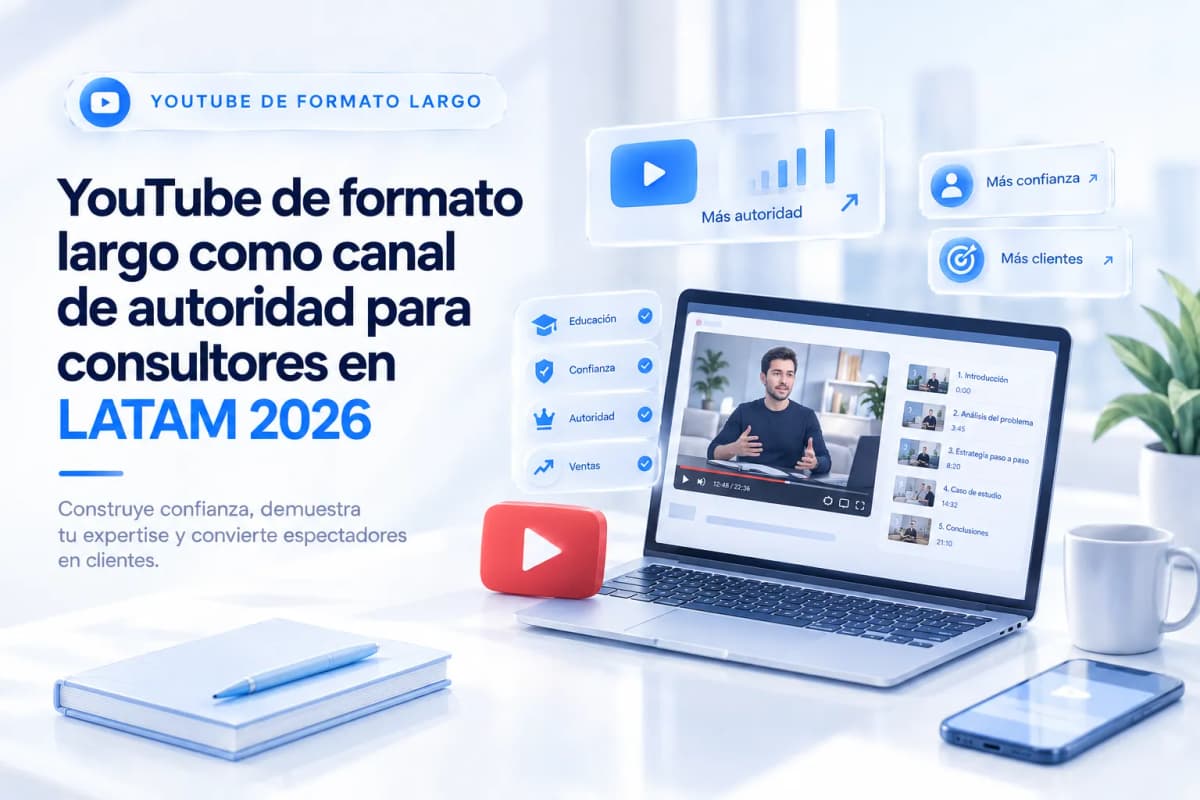
Every piece of video advice aimed at coaches and consultants assumes short form, and short form is built to get you discovered — not to make someone trust you enough to pay you thousands of dollars. Long form does the opposite: fewer people, far more depth, and a prospect who arrives at the call already convinced.
Short and Long Form Don't Compete — They Do Different Jobs
The mistake that makes people abandon long form is judging it by short-form metrics. A Reel with fifty thousand views feels like a win; a twenty-minute video with four hundred views feels like a failure. It can easily be the reverse, because they aren't doing the same job.
|
|
Short form |
Long form |
|---|---|---|
|
Job in the funnel |
Discovery |
Qualification and trust |
|
Who it reaches |
People who don't know you |
People who've seen you and want depth |
|
What it can demonstrate |
That you have something to say |
How you think and how you work |
|
Action it can ask for |
Follow, save, comment |
Book, message, hire |
|
How to measure it properly |
Reach and saves |
Retention and average view duration |
|
Speed of results |
Fast |
Slow |
That last row is this article's honest warning. Long form grows painfully slowly next to short form. If you judge it on views for the first three months, you'll quit before it starts working.
And it isn't right for every case. If your price point is low and the buying decision is quick, twenty minutes of video is over-engineering — short form converts better and cheaper. Long form pays for itself when the sale requires trust: multi-thousand-dollar services, decision cycles measured in weeks, buyers who need to understand how you reason before they hire you.
The Four Long-Form Formats That Build Authority
Not every long video builds authority. A thirty-minute unstructured monologue only proves you had time. These four work for services:
The client case explained in depth
The starting problem, the two or three decisions that changed the outcome, and what happened afterward. It's the single most persuasive format for services, because the prospect isn't evaluating your promise — they're watching your judgment applied to a problem that resembles theirs.
It requires client permission and real numbers. If you don't have them, don't invent them — use the next format instead.
The class that solves a complete problem
Take one concrete problem from your niche and solve it end to end, without holding back the important part for the sales call. This frightens people — "if I give everything away, why would they hire me?" — and the fear is misplaced: anyone who can solve it alone with your video was never going to be your client, and the people who do hire you do it precisely because they already verified that you know.
The critical review of a common practice in your niche
Take something everyone recommends and explain in detail why it works, why it doesn't, or under what conditions. It's the most differentiating format because it requires having a position of your own — and a position of your own is the one thing nobody can copy from you.
It works better when you critique the practice, not the people teaching it.
The conversation with a client or a peer
An interview or loosely structured conversation. It contributes two things a monologue can't: external credibility, and proof that your ideas hold up when someone questions them live. If the guest is a client, the case study tells itself — in their words, without feeling like a testimonial.
How to Structure a 15 to 30 Minute Video
Structure is what separates a long video that retains from one that loses half its audience by minute two.
- A concrete promise (first 15-30 seconds). What the viewer will be able to do by the end. No introduction, no credentials, no thanking people for subscribing. Your introduction comes later, once they've decided to stay.
- The map (30-60 seconds). State the three or four parts you'll cover. Knowing how much is left and where it's going is what sustains attention in long form.
- Development in blocks. Three or four self-contained sections. Each one closes with a line summarizing what you just established, because many people watch across two sittings and need re-entry points.
- The concrete example. One case, one real number, one shared screen. The block where you stop explaining and start showing.
- Close with a single action (last 30 seconds). One, not three.
What to cut without mercy: the long intro, the recap of your career before delivering any value, the subscribe request up front, and filler added to hit a target length. A fourteen-minute video with no filler retains better than a twenty-five-minute stretched one.
What gear actually matters
You don't need professional production, but three things do matter, in this order:
- Audio. It's the only thing an audience won't forgive. An inexpensive lavalier mic and a room without echo solve ninety percent of the problem. A video with good picture and echoey audio gets abandoned; clean audio with mediocre picture gets watched to the end.
- Structure. A well-organized video shot on a phone retains better than a disorganized one shot on a cinema camera.
- Front lighting. A window during the day or a diffused lamp in front of you. You don't need a twenty-inch ring light or a three-point setup.
What matters not at all in this format: transitions, background music, animated intros, and resolution above 1080p.
YouTube Search: Traffic That Arrives With Intent
This is the structural difference between YouTube and short-form networks. On Instagram or TikTok, your content reaches whoever the algorithm decides. On YouTube, it's also found by whoever is actively looking for it — and that doesn't expire: a video can still bring in prospects two years after you publish it.
How to pick topics by search rather than by personal interest:
- Type the beginning of the question your client would ask into YouTube's search bar and look at what autocompletes. Those suggestions are real searches.
- Read the comments on videos in your niche: repeated questions are topics with demand and no good published answer.
- Use the questions you already get on discovery calls. If three prospects asked the same thing this month, there's a video in it.
- Prefer the specific question over the general one. "How to structure a consulting proposal hourly vs per project" has less volume than "how to be a consultant" — and vastly more buying intent.
Your title and the first lines of the description determine whether you show up in that search. Write the title as the question the person would actually type, not as a creative headline.
How to Repurpose a Long Video Without It Showing
A well-structured twenty-minute video contains four or five short pieces, but clipping and posting them as-is is obvious and performs poorly.
What works: each block of your video was self-contained, so each one gets re-recorded as a short, not clipped. Thirty seconds shot deliberately for vertical, with its own hook, says the same thing and performs far better than a fragment cut out of the middle of a sentence.
When the literal clip is the right call: the moment with the most emotional weight, or the single most counterintuitive point in the video. There, the rawness works in your favor.
Order matters too. Publish the long video first, then the shorts across the following weeks, each pointing back to it. Reversed, the short burns the novelty and nobody goes looking for the extended version of something they already believe they understood.
The Long-Form CTA Is Different From the Short-Form One
Someone who reached minute eighteen of your video invested more time in you than most of your paid-traffic prospects ever will. Asking them to follow you wastes that.
In short form the correct CTA is very low commitment: follow me, save this, comment a keyword. In long form you can ask for the real next step — book a call, message me, request the diagnosis — because the viewer already did the work of evaluating you.
Three practical rules:
- One action per video. Offer three paths and the viewer takes none.
- The CTA goes at the end and once at the midpoint, briefly. Many people never reach the close.
- The description link must be visible before the description truncates. A link to your Calendly or to a wa.me with a pre-filled message outperforms a page with a navigation menu.
For the follow-up afterward, if you work with ASIO Messages you can set up the flow that answers the first WhatsApp message and logs the prospect in the CRM with the source recorded — so you know which video produced which conversation, which is the only thing that will let you decide what to record next.
Which Metrics Matter, and Why Views Aren't One
Views are the most visible and least useful indicator in this format. What matters:
- Average view duration. How long people stay on average. It's the central metric of long form, and the one YouTube uses to decide whether to recommend you.
- The retention curve. Not the number — the shape. The exact point where it drops tells you which part of the video is unnecessary. It's the most actionable information the platform gives you.
- Where the traffic came from. If it comes from search, the topic has sustained demand and is worth doing more of. If it comes from recommendations, it depends on the algorithm and is less predictable.
- Conversations started. How many people messaged or booked after watching. At the bottom of the funnel, this is the only one that pays for the production.
There is no universal retention or conversion threshold you can use as a benchmark, and any figure you find quoted as a standard depends so heavily on niche, length and traffic source that it won't help you decide anything. Your useful benchmark is your own history: compare each video against your last five, not against an internet average.
The signal that the channel is working isn't subscriber growth. It's prospects arriving at the first call saying "I've watched a few of your videos" — because that conversation closes differently.
Ready to Get More Clients?
At Asio, we teach you to implement these strategies step by step through the Mastery program — combining Meta Ads and conversational automation so you get more appointments and close more sales, without relying on manual messages.