Back to Blog
Evergreen Funnel vs Launch: When to Use Each Model to Sell Online Courses in the US, Canada, and UK
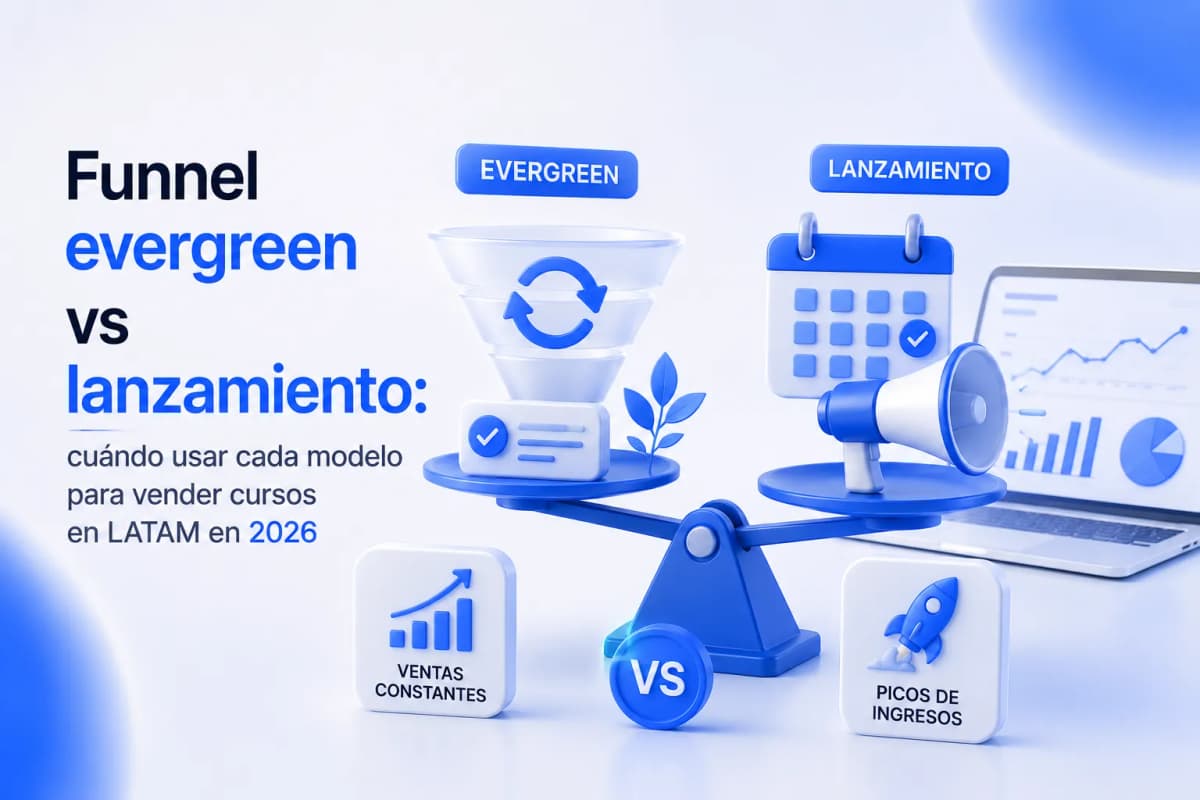
A launch generates revenue spikes in 5-7 days, but it's exhausting and can't be sustained more than twice a year. An evergreen funnel generates steady daily sales, but takes 3-6 months to optimize and requires working paid ads before it becomes profitable. Choosing the wrong model isn't a technical mistake — it's a strategic one that can burn months of energy with no return.
What an Evergreen Funnel Is and When to Use It
An evergreen funnel is an automated sales system that runs continuously — leads enter, move through an email and content sequence, and arrive at the course offer when they're ready to buy. There's no enrollment window, no artificial urgency, no operational spike of work.
When evergreen is the right choice:
- You have Meta Ads or Google Ads campaigns already generating leads at an acceptable cost
- Your course price is under $500 (higher-ticket offers need more conversation to close)
- You want daily sales without coordinating a launch every few months
- You've already validated the course with previous sales and know your audience's main objection
What evergreen requires to work: the funnel must be optimized. If the sales page copy doesn't convert, evergreen only scales the losses. The most common mistake is launching an evergreen with an unvalidated course: if the offer doesn't convert in a launch, it won't convert in an evergreen either.
What a Launch Is and When to Use It
A launch is a sales campaign concentrated in a 5-7 day window with a real close date that creates genuine urgency. The typical structure: audience warm-up phase (1-2 weeks) → cart open → launch email sequence → cart close.
When a launch is the right choice:
- You have an active owned audience (email list, community) of at least 500-1,000 qualified contacts
- Your course price exceeds $500 (higher-ticket offers convert better with real urgency and deadlines)
- You're validating a new course and want fast feedback before investing in automation
- You want concentrated revenue to fund the next phase of your business
What a launch requires to work: an owned, pre-qualified audience. Without an email list or engaged community, a launch depends 100% on cold ads — and conversion drops dramatically because the lead has no prior relationship with you.
Comparison: Evergreen vs Launch
|
Criterion |
Evergreen funnel |
Launch |
|---|---|---|
|
Revenue flow |
Steady (daily sales at low individual volume) |
Concentrated spikes (1-2 per year) |
|
Ideal course price |
Under $500 |
Over $500 |
|
Requires owned audience |
No (can scale with ads) |
Yes (email list, community) |
|
Best for validating a new course |
No |
Yes |
|
Initial setup time |
4-8 weeks |
2-4 weeks |
|
Time to stabilize |
3-6 months |
2-3 launches |
|
Operational energy level |
Moderate and ongoing |
High for 2-3 weeks + recovery |
|
Scalability |
High (with ads) |
Limited by audience size |
The 4 Launch Types That Work in English-Speaking Markets
1. Waitlist launch
You announce the course before it opens. Interested people register on a waitlist and get priority access (or a special price) when the cart opens. Works well for new courses because it lets you measure interest before producing the full content.
When to use it: the first time you sell a course, when you want to validate demand before committing to production.
2. Closed beta
You sell the course to a small group (20-50 people) at a reduced price, with the commitment that there will be live sessions or direct feedback from you. The beta gives you initial revenue, real testimonials, and clarity on what to improve before the main launch.
When to use it: when you have the course outline but not full production ready. Beta price is typically 40-60% of the final price.
3. List-based launch
The classic structure: 1-2 weeks of warm-up content (videos, emails, posts with real value related to the problem the course solves) → cart open → 5-7 days of sales with 3-4 follow-up emails → cart close. Conversion for this model with a qualified list is typically in the 2-5% range.
When to use it: when you have an email list of at least 500 active subscribers and an established relationship with your audience.
4. Affiliate launch
You recruit other people with aligned audiences (other coaches, creators, consultants) to promote your course to their communities during the launch window, in exchange for commission (typically 30-50%). Multiplies reach without depending on cold ads.
When to use it: when you have a stable version of the course with testimonials and a sales page that converts, and you have relationships with people who have access to your target audience.
Decision Tree: Which Model Is Yours?
Are you validating a course you've never sold before?
- Yes → Closed beta launch (20-50 people, reduced price, live sessions)
- No → continue
Do you have an email list or active community of more than 500 qualified people?
- No → Evergreen with ads (a launch without an owned audience depends 100% on cold traffic)
- Under $500 → Evergreen works well with ads and automation
- Over $500 → List-based launch + evaluate evergreen after the second launch
Do you want predictable monthly revenue?
- Yes → Evergreen (requires 3-6 months of patience to optimize)
- No, you prefer peaks → Launches (maximum twice a year to avoid burning your audience)
How to Combine Both Models: Launch to Validate, Evergreen to Scale
The right sequence for most online course creators:
Phase 1 — Validate with a launch (months 1-3): sell the course once or twice with a real close date. Collect testimonials, identify the main objections, refine your sales page copy, and confirm there's real demand at that price.
Phase 2 — Transfer to evergreen (months 4-6): with a validated sales page and real testimonials, convert the course into a permanent product. Activate ad campaigns, connect the traffic to the automated funnel, and begin the optimization period.
Phase 3 — Annual launches as a complementary peak: once or twice a year, run a launch to your list to generate a revenue spike and reactivate subscribers who didn't buy through the evergreen. The launch feeds the list; the evergreen monetizes it the rest of the year.
Tools for Each Model
|
Platform |
Best for |
Cost |
Key strength |
|---|---|---|---|
|
Kajabi |
Evergreen and premium launches |
$149+ USD/mo |
Best student experience, full branding control |
|
Systeme.io |
Evergreen |
$0-$27 USD/mo |
All-in-one: funnel, email, membership, courses |
|
Teachable |
Evergreen and launches |
$39-$119+ USD/mo |
Established platform, strong affiliate marketplace |
|
ConvertKit + Stripe |
List-based launches |
$25+ USD/mo |
Best email deliverability + direct payment |
For a first launch with a limited budget: Systeme.io free plan for the funnel and email sequence + Stripe or PayPal for payment processing covers 90% of what you need.
Key Metrics by Model
Launch:
- List conversion rate: 2-5% is the healthy range for a qualified list. Below 1%, there's a problem with the offer or the relationship with the audience.
- Email open rate during launch week: over 30% indicates an active list. Below 15%, the list is cold and the launch will generate very few sales.
- Early validation signal: if in the first 48 hours after cart open you don't have at least 40% of your total launch sales, the final conversion is likely to be low.
Evergreen:
- Minimum viable ROAS: 3x for the evergreen to be sustainable. At 2x ROAS, each sale just recovers the ad spend — no margin left to operate. At 4x+, you have enough margin to scale budget.
- Target CPA: Course price ÷ ROAS target = maximum CPA you can pay per sale. If your course costs $300 and you need 3x ROAS, your maximum CPA is $100.
- Optimization timeline: allow 60-90 days of data and at least 30-50 sales before scaling. Before that volume, the data isn't reliable enough for meaningful optimization decisions.
Ready to Get More Clients?
At Asio, we teach you to implement these strategies step by step through the Mastery program — combining Meta Ads and conversational automation so you get more appointments and close more sales, without relying on manual messages.