Back to Blog
Scaling Your Service Business Without Hiring More Staff (and Being More Profitable) with AI in 2026
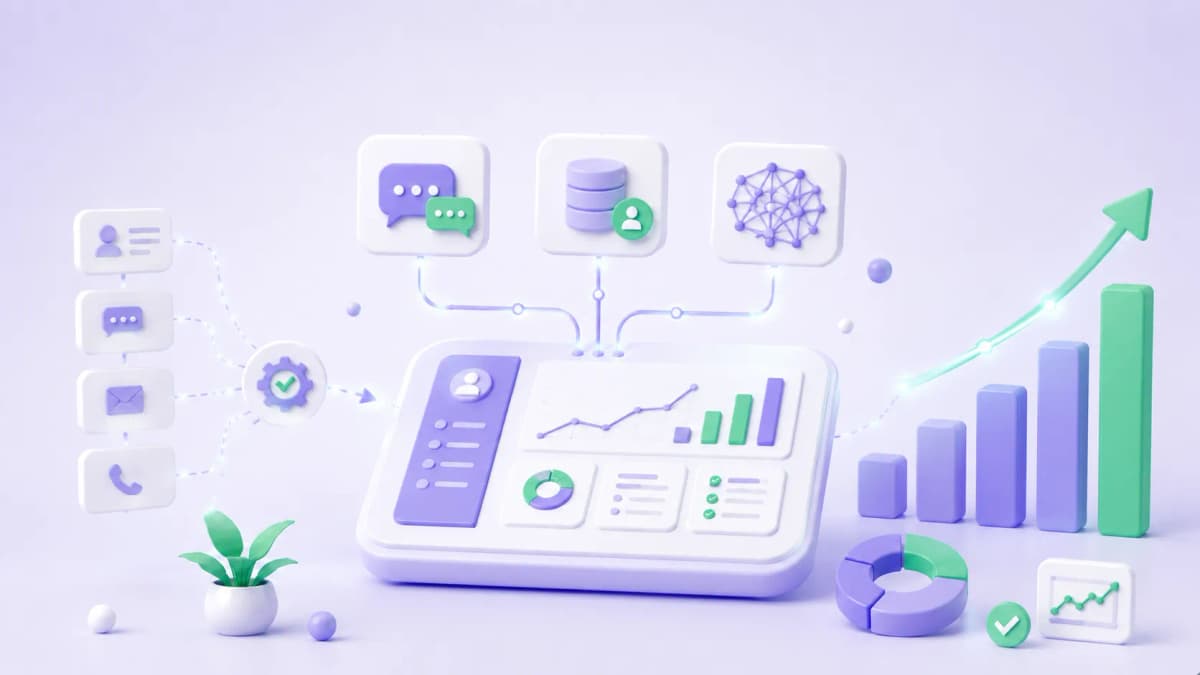
Most coaches, consultants, and freelancers who want to grow hit the same breaking point: more clients means more hours, and more hours means hiring. AI and automation break that equation — they let you multiply revenue without multiplying either hours or headcount. But there's a trap: automating broken processes just produces chaos faster. The right order is to systematize first, automate second.
What Tasks in a Service Business Can Be Automated Today
Not everything automates the same way. Some tasks automate completely; others semi-automate (AI does 80%, the human reviews and approves); others stay human by necessity. The key is identifying which tasks consume the most hours in the "fully automatable" category:
|
Task |
Tool |
Hours saved/week (estimate) |
Automation level |
|---|---|---|---|
|
Lead follow-up via WhatsApp |
ManyChat + WhatsApp Business API |
5–10 h/week |
Complete — bot manages the flow through to the discovery session |
|
Appointment reminders |
ManyChat / Calendly / ActiveCampaign |
2–4 h/week |
Complete — triggered automatically when booked |
|
New client onboarding |
Make + form + email/WhatsApp |
3–5 h/week |
Complete — welcome message, access credentials, materials sent automatically |
|
Campaign performance reports |
Make + Google Sheets / Looker Studio |
2–4 h/week |
Complete — data consolidated in automatic dashboard |
|
Recurring invoicing and payment |
Stripe / PayPal Subscriptions |
1–3 h/week |
Complete for recurring clients; semi-auto for new projects |
|
Inactive lead nurturing |
ActiveCampaign / ManyChat sequences |
3–6 h/week |
Complete — 7–30 day sequences with no intervention |
|
Initial prospect qualification |
ManyChat bot (4 questions) |
4–8 h/week |
Complete — only qualified prospects reach the call |
Conservative estimate for a consultant or freelancer who implements this stack: 20–40 hours per month returned to high-value work or to scaling client count.
How to Calculate the ROI of Automation
The formula is straightforward:
Monthly ROI = (hours saved/week × 4 weeks) × your hourly rate
Concrete example:
A marketing consultant who charges $100 USD/hour and spends 8 hours per week on manual lead follow-up and appointment reminders:
- Hours saved: 8 h/week × 4 weeks = 32 hours/month
- Value of those hours: 32 × $100 = $3,200 USD/month
- Implementation cost (ManyChat Pro + WhatsApp API + Make basic): ~$120 USD/month
- Net monthly ROI: $3,080 USD
Those 32 recovered hours can be used two ways: take on more clients (increase revenue) or reduce hours worked (increase profitability per effective hour). Both are valid ways to scale without hiring.
The incomplete calculation trap: most professionals only count the direct task time, not the context-switching overhead — opening WhatsApp, remembering where each lead is in the pipeline, deciding what to send, writing it. The real time cost of manual follow-up is 2–3x the task itself.
The 'Agency of One' Model: $10K–$20K USD/Month With 1–3 People
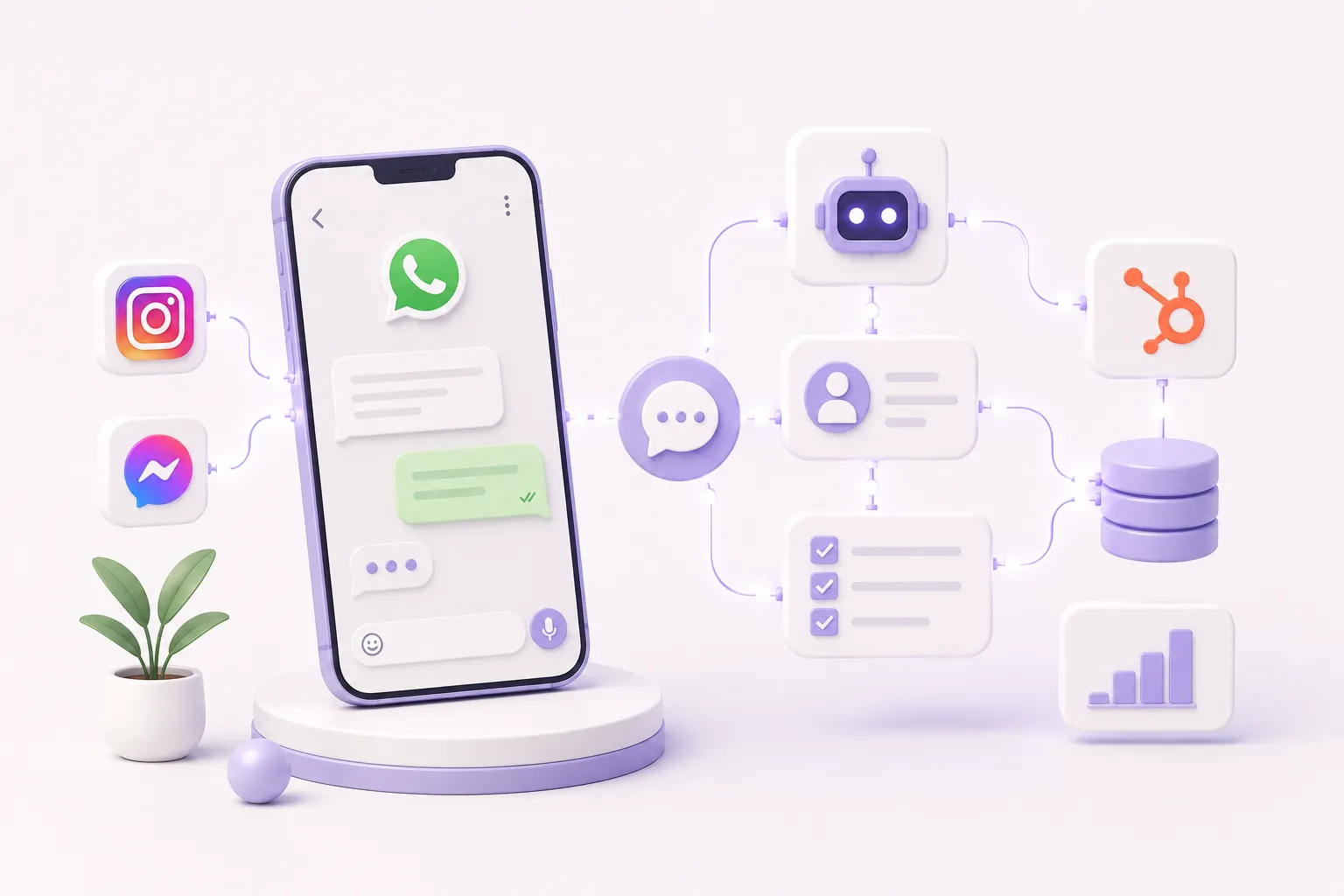
The "agency of one" model isn't an aspiration — it's a concrete operating structure. It works because it segments precisely what technology does and what the human does:
What the technology handles (basic stack):
- ManyChat manages lead capture, qualification, and follow-up via WhatsApp and Instagram
- CRM (HubSpot free or ActiveCampaign from $29/month) logs the full history of each prospect and client
- Make or Zapier automates onboarding, reports, and recurring billing
- Generative AI (ChatGPT / Claude) accelerates proposal writing, campaign content creation, and results analysis
What the human does (the 3 things you can't delegate to AI):
- Discovery sessions and sales closes
- Service delivery that requires strategic judgment
- Relationships with high-value clients
How you reach $10K–$20K/month with this model:
|
Setup |
Active clients |
Average ticket |
Monthly revenue |
|---|---|---|---|
|
Solo |
8–12 clients |
$1,200–$1,800 USD/month |
$10K–$22K |
|
1 implementation assistant |
15–25 clients |
$1,000–$1,500 USD/month |
$15K–$37K |
|
2–3 people (delivery + sales) |
30–50 clients |
$800–$1,500 USD/month |
$25K–$75K |
The difference between the professional billing $3K/month and the one billing $15K with the same level of expertise is almost always structural, not technical: the first handles manually what the second has automated.
Key constraint: the "agency of one" model has a ceiling. When active client count exceeds delivery capacity — typically 10–15 for high-touch service models — the next lever isn't more automation but a junior implementation person who executes under supervision.
The 3 Most Common Mistakes When Scaling a Service Business
Mistake 1: Hiring Before Systematizing
The most common reflex when a business grows: hire someone to handle the overflow. The problem is that if the process isn't systematized, the new hire learns to work the same chaotic way the owner does — and now the chaos costs more. The correct sequence: document the process, systematize it with tools, automate what you can, and only then evaluate whether human work remains to hire for.
Mistake 2: Automating Broken Processes
Automating a lead follow-up sequence that already has low conversion doesn't improve conversion — it makes it efficiently low at scale. If your call close rate is 10%, automating access to those calls gives you more calls with a 10% close rate. Automation amplifies what already exists, good or bad. Before automating: does this process work when a human does it? If not, fix it first.
Mistake 3: Scaling Without Defining a Client Ceiling
The service model has a physical capacity limit. Scaling without defining that limit leads to accepting more clients than you can serve well, which degrades quality, generates bad testimonials, and increases churn. The right lever is raising average ticket before raising client count: moving from 15 clients at $800/month to 10 clients at $1,500/month is more profitable and more sustainable.
Ready to Get More Clients?
At Asio, we teach you to implement these strategies step by step through the Mastery program — combining Meta Ads, ManyChat, and conversational automation so you get more appointments and close more sales, without relying on manual messages.